


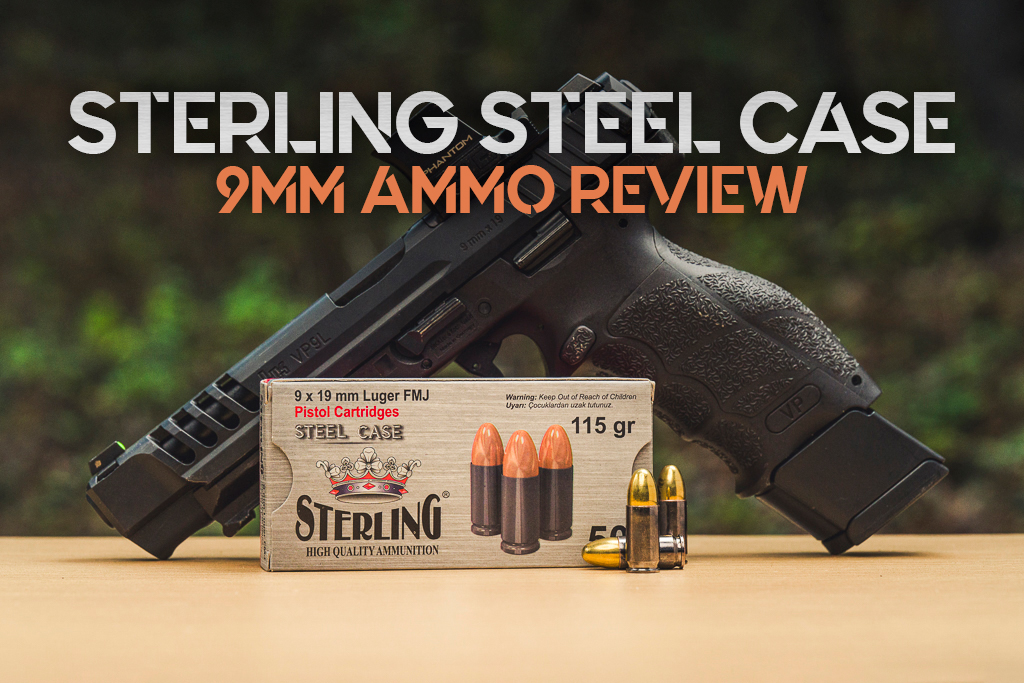
When it comes to shooting 9mm, ammunition costs can add up quickly. Whether you’re practicing fundamentals, running drills, or simply enjoying an afternoon plinking at the range, finding affordable ammunition is always a priority. That’s where Sterling Steel 9mm 115 Grain FMJ comes in.
Manufactured in Turkey by Turaç under the Sterling brand, this ammunition takes a budget-friendly approach to one of America’s most popular handgun cartridges. Instead of traditional brass cases, Sterling uses steel cases to help keep manufacturing costs down. But there’s more to this ammunition than its price tag.
The bullets also feature a bimetal jacket, making Sterling Steel somewhat different from the typical brass-cased, copper-jacketed 9mm loads found on store shelves. So, is Sterling Steel 9mm worth buying in bulk? Let’s examine its construction, potential performance, advantages, and drawbacks to determine where it fits into your shooting routine.
Specs: Sterling Steel 9mm 115 Grain FMJ
| Specification | Details |
|---|---|
| Manufacturer | Sterling (Turaç) |
| Country of Origin | Turkey |
| Caliber | 9mm Luger (9x19mm) |
| Bullet Weight | 115 grains |
| Bullet Type | Full Metal Jacket (FMJ) |
| Bullet Core | Lead |
| Bullet Jacket | Bimetal (steel with copper surface) |
| Case Material | Steel |
| Primer | Boxer, noncorrosive |
| Magnetic Projectile | Yes |
| Intended Use | Target shooting & practice |
| Bulk Packaging | 1,000 rounds (20 boxes of 50) |
Ballistics & Performance
Sterling’s 115-grain FMJ bullet falls into one of the most widely used categories of 9mm range ammunition. Typical standard-pressure 115-grain FMJ loads produce muzzle velocities somewhere around 1,100 to 1,200 feet per second, depending on the manufacturer and barrel length. A 115-grain bullet generally produces a relatively flat trajectory at common handgun distances, making it suitable for recreational target shooting and basic marksmanship practice.
H&K VP9L Compared
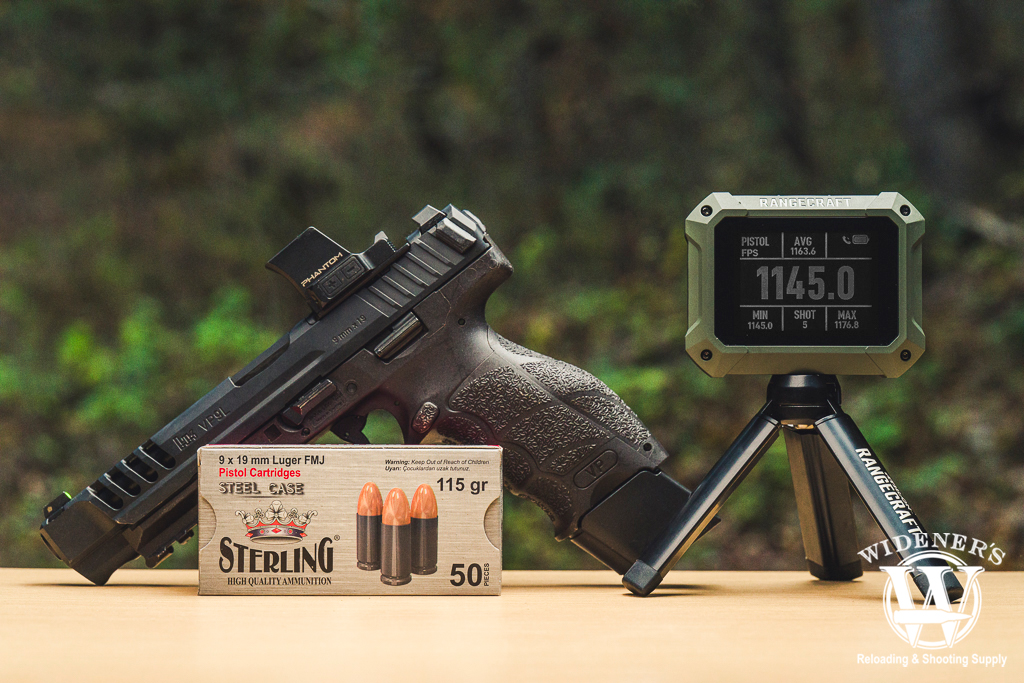
The H&K VP9L handled the Sterling Steel 9mm without an issue. Would you expect anything less from an H&K?
As expected, the H&K VP9L ate through 100 rounds of Sterling Steel 9mm without a single issue. During our range test, we noticed that every 4th or 5th round sparked on ejection. Recoil was minimal; accuracy on our paper targets at 10 and 25 yards was respectable.
At 10-25 yards, shooters should expect performance similar to other conventional 115-grain FMJ ammunition.
For a competitor, shooting Sterling Steel 9mm could add up to a serious cost savings. It’s also a time-saver. The less time you spend reloading, the more time you’ll have to shoot.
| Caliber | Bullet Type | Bullet Weight | Box Velocity (Muzzle) | Box Energy (Muzzle) | Velocity (5 Shot Average) | Energy (5 Shot Average) | H&K VP9L (Velocity/Energy) |
|---|---|---|---|---|---|---|---|
| 9x19mm | FMJ | 115gr | 1,180 FPS | 356 FT LBS | 1,176 FPS, 1,165 FPS, 1,158 FPS, 1,145 FPS, 1,146 FPS | 353 FT LBS, 347 FT LBS, 342 FT LBS, 335 FT LBS, 336 FT LBS | 1,163 FPS/345 FT LBS |

Magtech Steel 9mm 115 Grain FMJ – 1000 Rounds **STEEL CASES**
$237.85
Shop Now

Wolf 9mm 124 Grain FMJ – 1000 Rounds (STEEL CASES)
$239.85
Shop Now

Magtech Steel 9mm 115 Grain FMJ – 50 Rounds **STEEL CASES**
$13.85
Shop Now

Magtech Steel 9mm 124 Grain FMJ – 50 Rounds *STEEL CASES*
$13.85
Shop Now

Sterling Steel 9mm 115 Grain FMJ – 1000 Rounds

Sterling Steel 9mm 115 Grain FMJ – 50 Rounds
$13.85
Shop Now

Winchester USA Forged Steel Cased 9mm 115 Grain FMJ - 500 Rounds
$124.85
Shop Now


Glock 43 Compared
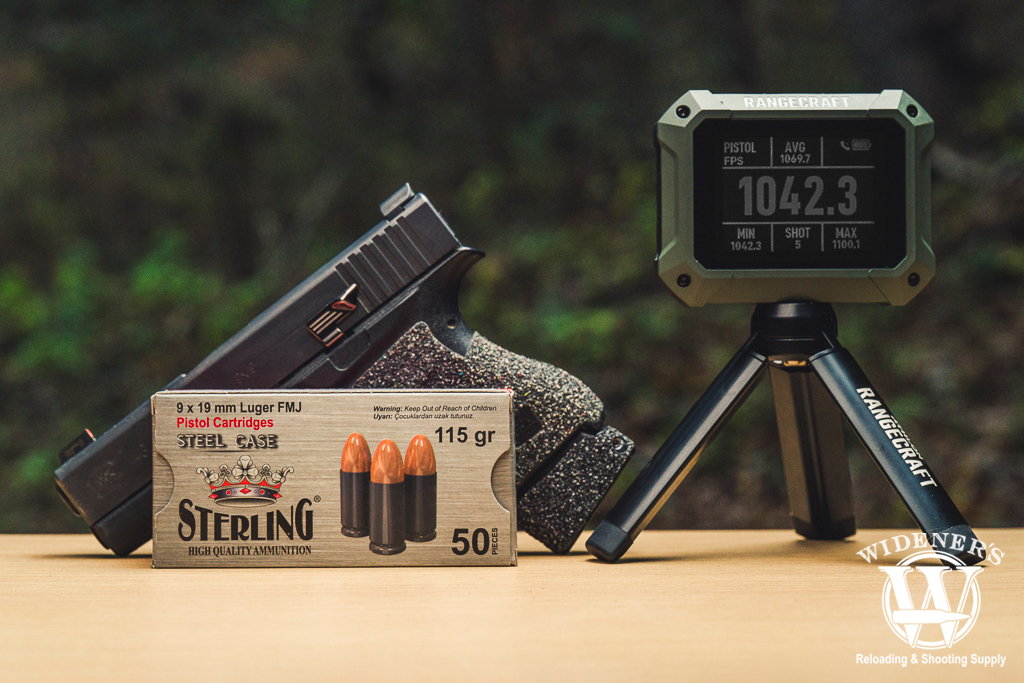
The Glock 43 ran the Sterling Steel with minimal stoppages and no feeding failures. Not bad for a little fella.
The Glock 43 handled the Sterling Steel 9mm well. During our 100-round test, we recorded only one ejection failure at about 20 rounds in. Recoil was very manageable, and accuracy was as you’d expect from a 3.4″ barrel at 10 and 25 yards.
If you’re running a self-defense load like Hornady 115 grain FTX, these rounds make a lot of sense to train with at the range.
For defensive handgun owners, inexpensive FMJ ammunition can be useful for practicing grip, sight alignment, trigger control, and follow-through without spending premium defensive-ammunition prices.
| Caliber | Bullet Type | Bullet Weight | Box Velocity (Muzzle) | Box Energy (Muzzle) | Velocity (5 Shot Average) | Energy (5 Shot Average) | Glock 43 (Velocity/Energy) |
|---|---|---|---|---|---|---|---|
| 9x19mm | FMJ | 115gr | 1,180 FPS | 356 FT LBS | 1,100 FPS, 1,092 FPS, 1,083 FPS, 1,058 FPS, 1,042 FPS | 309 FT LBS, 304 FT LBS, 299 FT LBS, 286 FT LBS, 277 FT LBS | 1,069 FPS/292 FT LBS |
Magtech Steel 9mm 115 Grain FMJ – 1000 Rounds **STEEL CASES**
$237.85
Shop Now
Wolf 9mm 124 Grain FMJ – 1000 Rounds (STEEL CASES)
$239.85
Shop Now
Magtech Steel 9mm 115 Grain FMJ – 50 Rounds **STEEL CASES**
$13.85
Shop Now
Magtech Steel 9mm 124 Grain FMJ – 50 Rounds *STEEL CASES*
$13.85
Shop Now
Sterling Steel 9mm 115 Grain FMJ – 1000 Rounds
Sterling Steel 9mm 115 Grain FMJ – 50 Rounds
$13.85
Shop Now
Winchester USA Forged Steel Cased 9mm 115 Grain FMJ - 500 Rounds
$124.85
Shop Now
First Impressions: A No-Frills Approach to 9mm
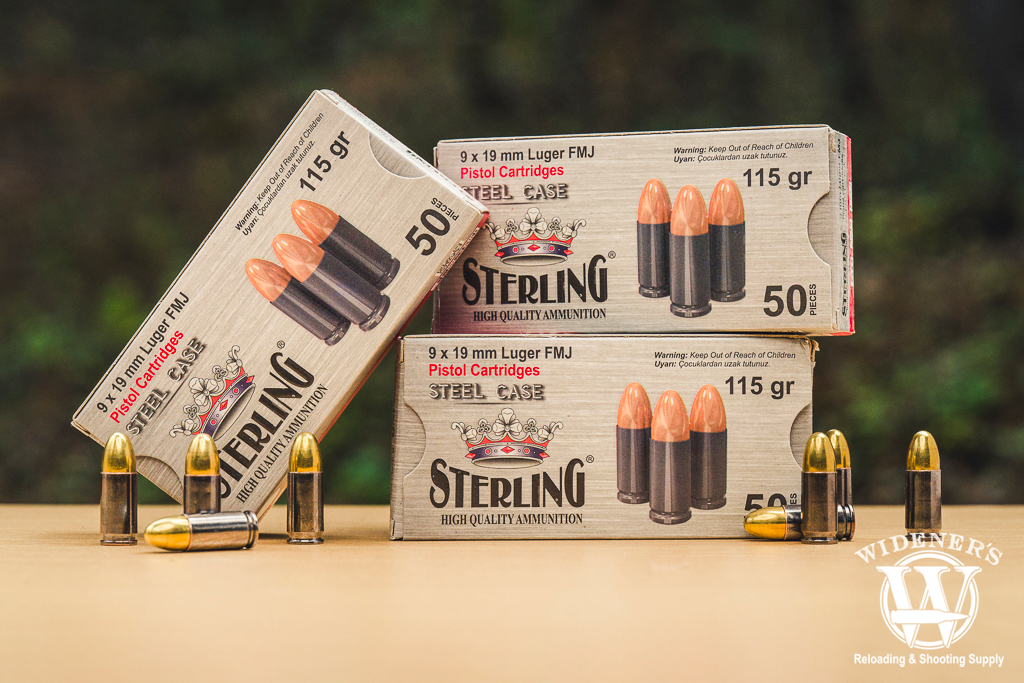
Sterling Steel provides shooters with affordable ammunition for everyday range use.
Sterling Steel isn’t trying to compete with premium defensive ammunition or specialized match-grade cartridges. Instead, it focuses on something considerably more practical: providing shooters with affordable ammunition for everyday range use. The 115-grain FMJ bullet is a familiar choice.
It’s one of the most common projectile weights for 9mm Luger, offering manageable recoil, relatively high velocity, and broad compatibility with modern 9mm firearms.
For shooters accustomed to standard 115-grain practice ammunition, Sterling Steel should feel familiar in terms of its general shooting characteristics. However, its steel cases and bimetal jackets introduce a few important considerations that distinguish it from conventional brass-cased alternatives.
Steel Cases: The Biggest Difference
The most obvious feature of Sterling Steel 9mm is its steel cartridge case. Most American shooters are familiar with brass-cased ammunition. Brass is relatively soft, corrosion-resistant, and expands against the chamber walls during firing before contracting enough to facilitate extraction. Steel cases behave somewhat differently.
Steel is generally less elastic than cartridge brass, meaning it doesn’t expand and contract in quite the same way. This can affect how effectively the case seals the chamber during firing and how easily it extracts afterward. Consequently, some firearms may experience more fouling or occasional extraction difficulties with steel-cased ammunition.
That doesn’t mean steel cases are inherently unreliable. Plenty of modern firearms handle them without significant problems. However, reliability can vary depending on chamber dimensions, extractor condition, firearm design, and maintenance.
The primary advantage is cost. Steel is typically less expensive than brass, allowing manufacturers to produce ammunition at a lower price point. For shooters who regularly burn through several hundred rounds during a range session, those savings can become meaningful.
One disadvantage is reloadability. Although Sterling uses Boxer primers, steel cases are generally less desirable for conventional handloading than brass. Most recreational reloaders will prefer to leave these cases behind.
Bimetal Jackets: What Shooters Should Know
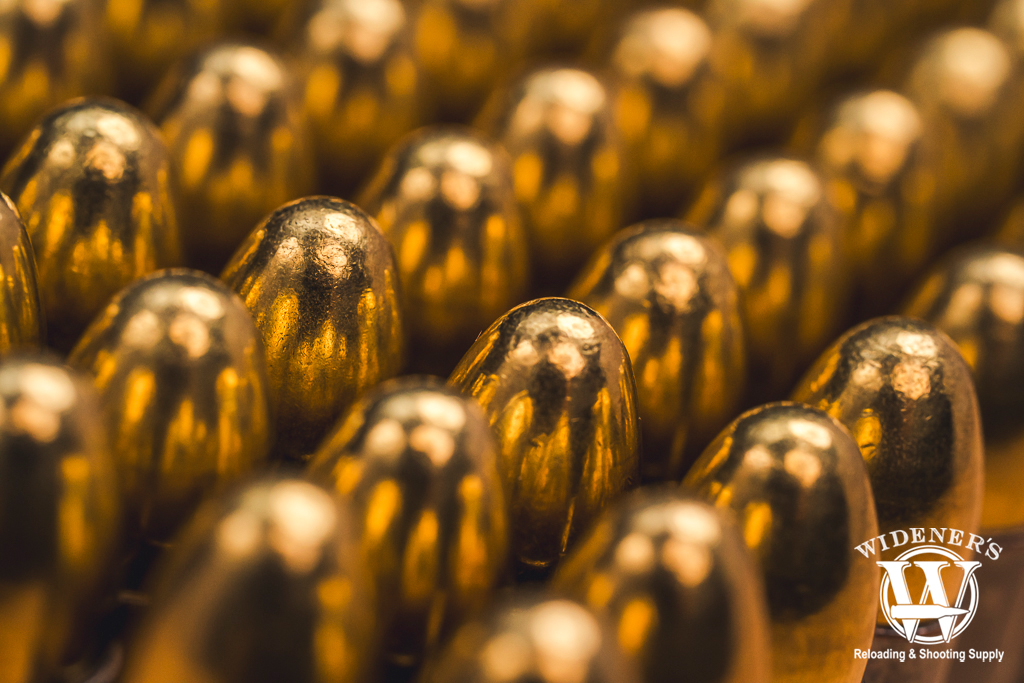
Sterling uses a bimetal jacket consisting primarily of steel with a thin copper exterior.
Another important characteristic of Sterling Steel 9mm is its bullet construction. Unlike traditional FMJ ammunition with a copper-alloy jacket, Sterling uses a bimetal jacket consisting primarily of steel with a thin copper exterior. The bullet itself has a lead core, so this isn’t an armor-piercing projectile. The steel component is part of the jacket, not a hardened penetrator.
Nevertheless, the bimetal construction makes the projectile magnetic. This matters because some shooting ranges prohibit ammunition containing steel-jacketed bullets. Indoor facilities, particularly those using certain steel backstops or bullet traps, may restrict magnetic projectiles because of concerns about backstop damage and sparks.
Even some outdoor ranges prohibit steel-jacketed ammunition. Before buying a case of Sterling Steel, check your range’s ammunition policy.
Reliability: Will It Run in Your Firearm?
Reliability is arguably the most important consideration when evaluating budget ammunition. A low price means very little if a cartridge consistently fails to feed, fire, extract, or eject. Sterling Steel’s standard 115-grain FMJ configuration should be familiar to firearms designed for 9mm Luger ammunition. However, steel cases can introduce variables that aren’t always present with brass-cased loads.
Some pistols handle steel-cased ammunition without hesitation, while others may experience extraction problems or inconsistent cycling.
We had no issues cycling the ammo in any of the guns we tested. It did produce sparks on ejection, but the frequency varied by firearm. As with any ammunition, follow the firearm manufacturer’s recommendations regarding acceptable cartridge types.
Cleaning & Maintenance Considerations
One potential tradeoff associated with steel-cased ammunition is increased fouling. Because steel cases may not seal the chamber as effectively as brass, more combustion residue can sometimes escape around the case during firing. This may leave additional carbon buildup inside the chamber and action. If you clean your guns after range trips, you likely won’t notice an issue.
Sterling Steel uses noncorrosive primers, so there’s no special corrosive-primer cleaning procedure required. Nevertheless, shooters using steel-cased ammunition should pay attention to chamber cleanliness, especially during extended range sessions. Regular cleaning and inspection can help reduce the likelihood of extraction problems caused by accumulated residue.
Wear & Tear
Another consideration is barrel wear. Bimetal-jacketed projectiles can produce greater barrel wear over extended firing schedules than conventional copper-jacketed ammunition. The practical significance depends on the firearm, shooting volume, and ammunition characteristics.
For an occasional recreational shooter, the difference may be relatively minor. High-volume shooters should weigh potential long-term wear against the savings offered by inexpensive ammunition.
Is Sterling Steel 9mm a Good Value?
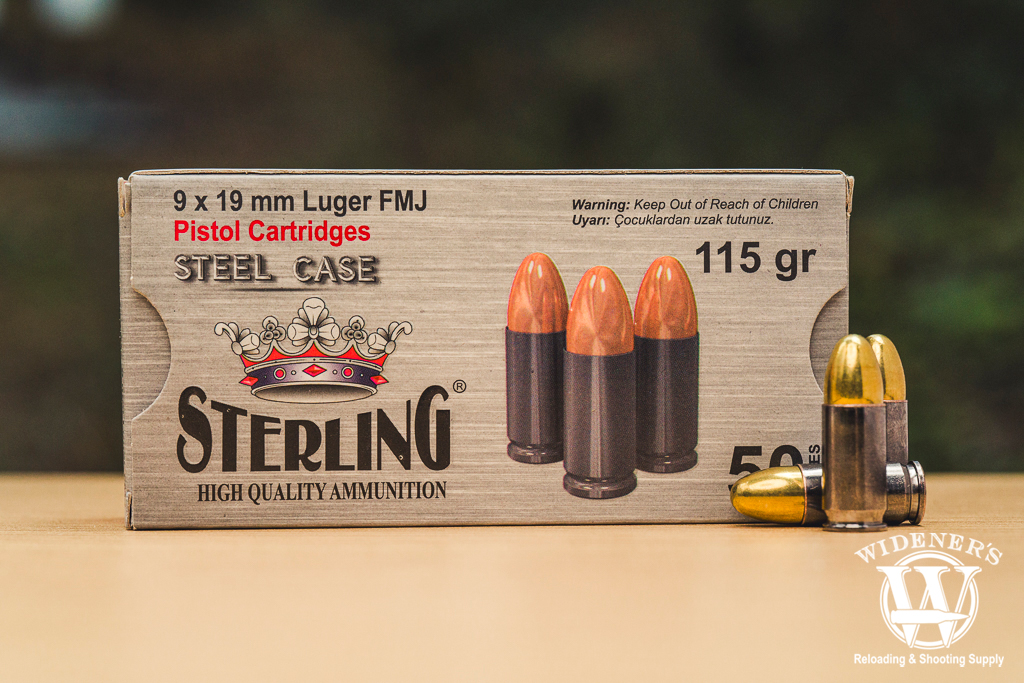
The value proposition is where Sterling Steel case ammunition makes its strongest case.
For high-volume shooters, the cost per round often matters more than packaging, appearance, or brand recognition. Consider the difference between ammunition costing 23 cents per round and a brass-cased alternative costing 28 cents. Over 1,000 rounds, that five-cent difference amounts to $50 in savings.
For someone shooting several thousand rounds annually, the savings can become substantial.
Of course, the equation changes if your local range prohibits magnetic ammunition or your firearm struggles with steel cases. Shooters who reload their brass may also find that conventional brass-cased ammunition offers better long-term value. Ultimately, Sterling Steel makes the most financial sense when it’s noticeably cheaper than comparable brass-cased options, and your firearm handles it reliably.
Pros & Cons
Pros
•Steel cases can offer meaningful savings compared with brass.
•Familiar 115-grain FMJ bullet weight for recreational shooting.
•Noncorrosive Boxer primers.
•Available in economical 1,000-round bulk quantities.
•Suitable for routine practice when compatible with the firearm and range.
Cons
•Magnetic bimetal bullets may violate range restrictions.
•Steel cases aren’t practical for most conventional reloading.
•Limited firearms may experience extraction or cycling issues.
•Potential for increased chamber fouling.
•Bimetal bullets may increase barrel wear over extended use.
Final Verdict: Is Sterling Steel 9mm Worth Buying?

Sterling Steel: A straightforward budget ammo option for shooters who prioritize affordability over premium components.
Its biggest selling point is simple: inexpensive ammunition makes it easier to spend more time practicing. The familiar 115-grain FMJ bullet offers a practical configuration for target shooting, while the steel case helps reduce production costs. However, this ammunition isn’t necessarily the best choice for everyone.
Shooters whose ranges prohibit magnetic projectiles should look elsewhere. The same applies to reloaders who want reusable brass or firearm owners whose pistols struggle to extract steel cases. For those with compatible firearms and access to ranges that permit bimetal-jacketed ammunition, Sterling Steel is an affordable training option.
Sterling Steel 9mm 115 Grain FMJ is worth considering when the savings over brass-cased ammunition justify its trade-offs. Test it in your firearm first, confirm your range permits magnetic bullets, and compare the cost per round to see if it’s right for you.
You may also like