



Stand Your Ground laws have become a defining feature of American self-defense jurisprudence, dramatically altering the legal landscape regarding when and how individuals may use force, sometimes deadly, in response to perceived threats. Understanding these laws requires a look at their historical roots, how they differ across states, the conditions under which they apply, and how they can be misapplied or violated.
Origins & Historical Context
The concept underpinning Stand Your Ground laws is not entirely new. It’s a descendant of the “castle doctrine,” a legal principle dating back to the Middle Ages. The castle doctrine asserts that a person’s home is their castle. This grants them the right to defend it against intruders without the obligation to retreat. The idea is that individuals should not be forced to flee from their own homes in the face of danger.
For centuries, the broader application of self-defense law (especially in public spaces) followed the “duty to retreat” principle inherited from British common law. Under this standard, a person facing a public threat must withdraw before resorting to force. This approach prioritized de-escalation and avoidance of violence.
The modern Stand Your Ground movement began in earnest in the United States in 2005. Florida became the first state to pass such a law. This legislation expanded the castle doctrine to all public spaces, removing the duty to retreat. Doing so allowed individuals to meet force with force wherever they were lawfully present. Lobbying efforts, particularly from the National Rifle Association (NRA), heavily influenced the law’s passage and marked a significant shift in American self-defense law.
Stand Your Ground Laws: State to State
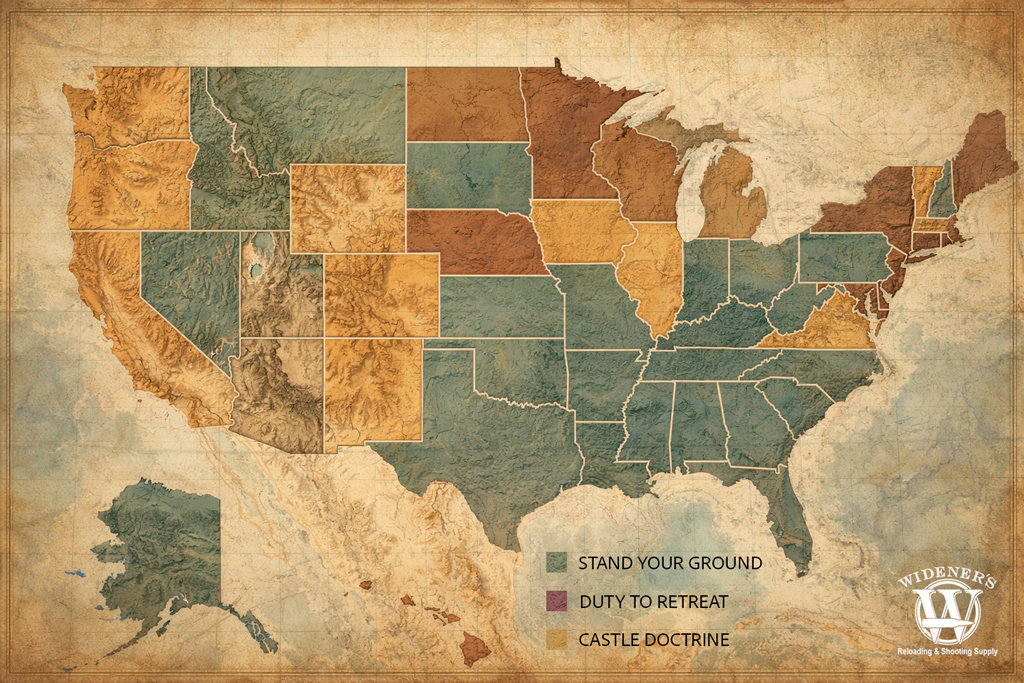
Many states have “stand your ground” policies, removing the legal duty to retreat from an attacker in any place a person is lawfully present.
Since Florida’s pioneering statute, Stand Your Ground laws have become more popular across the United States, but their specifics vary widely. As of early 2025, 38 states have some form of Stand Your Ground law, either through explicit statutes or judicial interpretations. That means 12 states don’t have a Stand Your Ground law.
Do you live in one of those? Are you familiar with your state laws and what you can and cannot do to defend yourself or others around you? It’s best to familiarize yourself with those laws before something bad happens.
Conditions Under Which Stand Your Ground Laws Apply
Though often broad, applying Stand Your Ground laws is not without limits. Several conditions typically must be met to successfully claim protection under these statutes.
- The person using force must be in a place where they have a legal right to be. Intruders and others engaged in unlawful activities generally don’t enjoy Stand Your Ground protections.
- There must be a reasonable belief that using force is necessary to prevent imminent harm. This belief is judged from the perspective of a “reasonable” person in the same situation. The threat must also be immediate and not speculative. For example, if someone is threatened with a deadly weapon or faces an imminent risk of serious bodily harm, deadly force may be justified. The phrase “reasonably believes” appears in many states’ Stand Your Ground laws and other self-defense laws. This deliberately adds enough ambiguity to encompass a range of explanations that might convince a jury the person acted within the law. Remember, in many cases, guilt or innocence comes down to whether the jury becomes convinced one way or the other.
- The force used must be proportionate to the threat. Using deadly force in response to a minor, non-lethal threat is not protected under Stand Your Ground laws and can result in criminal charges.
- The person claiming self-defense must not have provoked the confrontation. If someone initiates a conflict or acts as the aggressor, they typically lose the right to claim Stand Your Ground.
- Some states require that the person using force not be engaged in any criminal activity at the time. For instance, a person committing a robbery cannot claim self-defense under Stand Your Ground if confronted by a victim.
A minority of states still require a duty to retreat, except in the home or other narrowly defined circumstances.
Violations & Misapplications of Stand Your Ground Laws
Despite their intent to clarify and broaden self-defense rights, these laws are not a carte blanche for using force or a 007 “license to kill.” There are several ways these laws can be violated or misapplied.
Excessive or disproportionate use of force is also a violation. If one responds to a minor threat with deadly force, courts may find it disproportionate, leading to criminal liability. For example, most states do not allow deadly force to defend property. Shooting someone attempting to steal a car, would not be justified under Stand Your Ground.
Self Defense In the News
Stand Your Ground laws can be misused as a pretext for violence or vigilantism. Critics claim these statutes embolden individuals to start confrontations or unnecessarily escalate, mistakenly believing the law will protect them regardless of the circumstances. Yet, courts have repeatedly clarified that Stand Your Ground is not a license to seek out or provoke violence.
There have also been high-profile cases highlighting Stand Your Ground laws. In one example, the shooting death of Trayvon Martin looked at first as if it might have been illegal. However, the jury ruled that Florida law justified Zimmerman’s use of deadly force.
Conversely, the individuals who pursued and killed Ahmaud Arbery in Georgia attempted to invoke Stand Your Ground. Nevertheless, the circumstances of pursuing and confronting a person not engaged in a crime did not meet the law’s requirements. They were subsequently found guilty of murder and sentenced to prison. In the Arbery case, a video of the incident was a key deciding factor for the jury.
Recap: Stand Your Ground Laws

To lawfully stand your ground, you must be in a place where you have a right to be, and face an immediate and reasonable threat.
Stand Your Ground laws represent a significant evolution in American self-defense law. They shift the balance away from de-escalation and retreat toward a broader right to use force in the face of perceived threats. Their origins lie in the centuries-old castle doctrine, but their modern incarnation is a product of recent legislative and cultural shifts. While these laws now cover the majority of U.S. states, their application is far from uniform, with important differences in scope, requirements, and limitations.
The rules are generally clear. To lawfully invoke Stand Your Ground, individuals must be in a place where they have a right to be, face an immediate and reasonable threat, use force proportionate to that threat, and not be the initial aggressor or engaged in criminal activity. Violating any of these conditions can result in criminal prosecution. Recent high-profile cases have shown that courts carefully scrutinize self-defense claims under Stand Your Ground.
Ultimately, while Stand Your Ground laws provide expanded rights to self-defense, they also carry significant responsibilities. Understanding the nuances of these laws and their potential for both protection and misuse is essential for anyone seeking to navigate the complex intersection of personal safety and legal accountability in the United States.
Want to learn more about self-defense topics like the Castle Doctrine? Check out our helpful article here!
You may also like
