

Ever wonder what military camouflage patterns each branch of the service uses? This guide provides a clear overview of the camouflage (“camo”) patterns worn by the U.S. armed forces. We cover many types of military camo, including the Army, Navy, Marines, and even Special Ops.
The US Military uses a wide array of camouflage due to its vast operational needs. There are distinctions between the various branches of the military, with the US Army using a different kind of camouflage than the Marines, and so forth. In part, this is due to the inherent differences in their mission; however, it’s also a way to draw a line between disciplines.
History of Military Camouflage Patterns in the United States
Though camouflaging yourself during a hunt or battle might seem like an intuitive idea, it wasn’t widespread in the United States Military until the 1940s. Even during the Second World War, camouflage uniforms did not see use in the same way as today.
Of course, for many thousands of years, humans have camouflaged themselves in different ways for hunting or certain battle situations, so it’s not as though the idea of camouflage is brand new; it’s just that what we think of as “camo” has only been widespread for about 70 years.
If we go back far enough, we find people using body paints and even items like animal fur to disguise themselves. Interestingly, many modern camouflages draw inspiration from animals, with some known as “Tiger Stripe” and others as “Duck Pattern” or “Frogskin.”
Like the environment around us, camouflage patterns often change to meet the needs of the military and their missions.
Common Types of US Military Camouflage Patterns
We’ll break down camouflage patterns by various branches of the military. Then, we’ll delve into the unique history of each pattern, discuss what makes it distinct from (or similar to) other branches, and outline some of the reasons past camouflage patterns have failed.
Here are the most common military camouflage patterns we’ll cover:
- US ARMY OCP
- United States Marines MARPAT
- United States Navy (NWU 1, 2, and 3) Camo Patterns)
- United States Air Force Camo Pattern
- US Space Force Camouflage
- Camo Worn by Special Forces
Military Camouflage Patterns: US Army

The Operational Camouflage Pattern (OCP) is used by the US Army, Air Force, and Space Force.
The United States Army uses what’s known as the Operational Camouflage Pattern, or OCP. This pattern is also sometimes known as the “Scorpion” or, more specifically, the “Scorpion W2.” You will find this pattern currently on the Army Combat Uniform, otherwise known as the ACU.
The Operational Camouflage Pattern is a new, upgraded iteration of Multi-cam, a common pattern for many years. This Operational Camo Pattern replaced the Universal Camouflage Pattern or UCP, which was not very popular.
What was so bad about the Universal Camo Pattern? There were several issues. First, the lack of testing when the Army adopted UCP. From the sounds of it, the Army rushed this pattern into production rather than carefully testing it.
The result? The overall pattern of UCP did not create effective camouflage in the Afghanistan desert. Some soldiers even felt their uniforms made them easier to spot. The goal of any camouflage is to create effective concealment at both near and far distances, and the UCP made them look more like a big, obvious blob.
Do Soldiers Like the OCP?
Opinions on camouflage will always have a hint of personal preference—there are those who like it and those who don’t. However, for the most part, soldiers enjoy the OCP pattern more than the UCP, which was disliked not only for its aesthetic but also for its ineffectiveness.
The US Army introduced the Operational Camouflage Pattern around 2015. This is when the UCP became more scarce and OCP took over.
What Kind of Environment was the OCP Designed for?
The pattern was designed for use in both desert regions and more traditional woodland areas, where a soldier might need concealment within trees and shrubs.
What Does OCP Look Like?
The pattern is classic and rich in color, featuring bold browns and greens that have a distinctive signature. You could say that the operational camo pattern “stands out,” though that would be a bit counterintuitive. Perhaps it’s better to say that it does its job well while also looking good. The specific color palette consists of four main colors: traditional brown, a darker brown, a light brownish grey, and a muddy woodland green.
Unique Features of OCP
This pattern is also used by the US Space Force and the US Air Force, cementing its effectiveness and proving popular among the troops.
Military Camouflage Patterns: The US Marine Corps
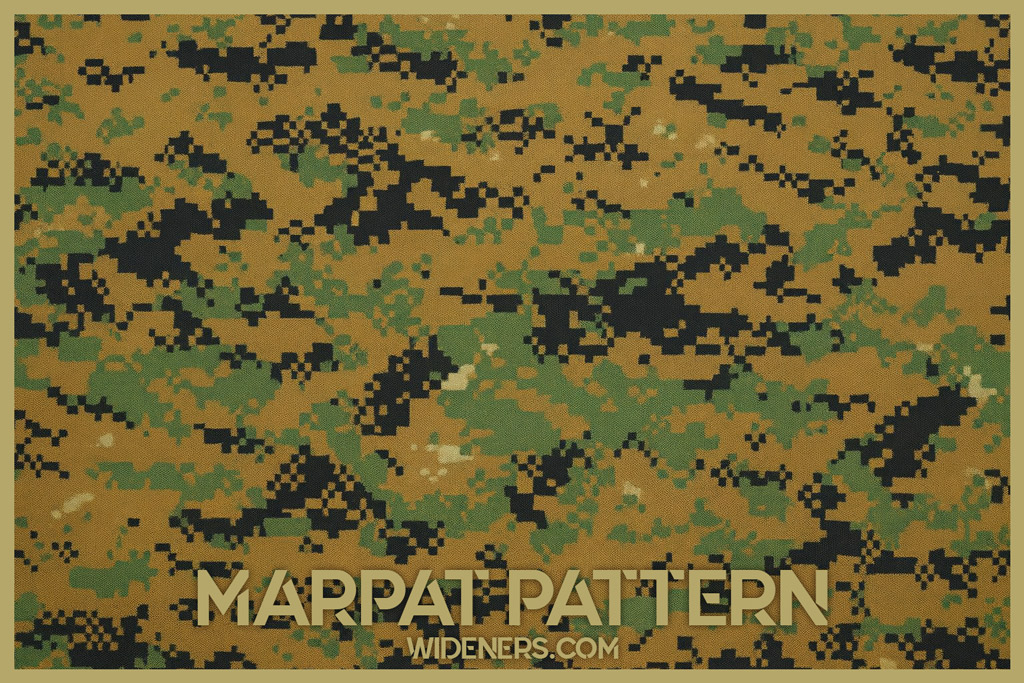
The unique MARPAT camouflage pattern is used exclusively by the US Marine Corps.
As you might expect, the Few and the Proud employ a type of camouflage unique to the Marines. In some cases, when other branches of the military tried to adopt the Marines’ style, they encountered pushback. The Marines’ camouflage pattern is known as “MARPAT,” which stands for “Marine Pattern.”
What Does MARPAT Look Like?
MARPAT is a solid mix of what we might think of as traditional “blotchy” camouflage and more modern digital camouflage. The MARPAT has natural-looking mixes of browns, greens, and beiges. It blurs the edges with the careful use of small, pixelated rectangles that are the hallmark of digital-based camouflage.
Where Did the MARPAT Design Come From?
The MARPAT design was largely based on the Canadian Disruptive Pattern, or CADPAT. However, these are not copies, as the CADPAT and MARPAT designs feature distinct colors. Still, the foundational scheme of the two patterns is quite similar.
When Was the Marines’ MARPAT Camouflage Designed?
Designed around 2001, it was introduced in 2002. However, if we consider the lineage of CADPAT, its history dates back to the early 1990s, when the pattern was initially designed and tested.
What Environment is MARPAT Made For?
There are actually three different versions of MARPAT. The first is woodland-themed, featuring colorations similar to those of a deciduous forest, with rich greens, dark browns, and lighter beiges.
There’s also MARPAT for desert regions, featuring a light color palette of desert-brown shades with some sandy tones.
Finally, there is a MARPAT camo designed for snowy winter environments. Although this is still referred to as MARPAT, it represents a significantly different design from the other iterations. For the winter MARPAT variation, there’s a baseline of white with grey boxes here and there.
Unique Features of MARPAT Camo
There’s a little game of hide and seek within the pattern. On official Marine camouflage, you can find the USMA EGA symbol embedded within the camouflage here and there. This is partly to make the camouflage special, but it’s also a trademark. It discourages anyone from copying their design and signifies when a Marine uniform is official.
The Marines also had an urban MARPAT design to help them blend in against buildings and large infrastructure. This design was not widely adopted and was not commonly seen in any official capacity.
Military Camouflage Pattern: US Navy
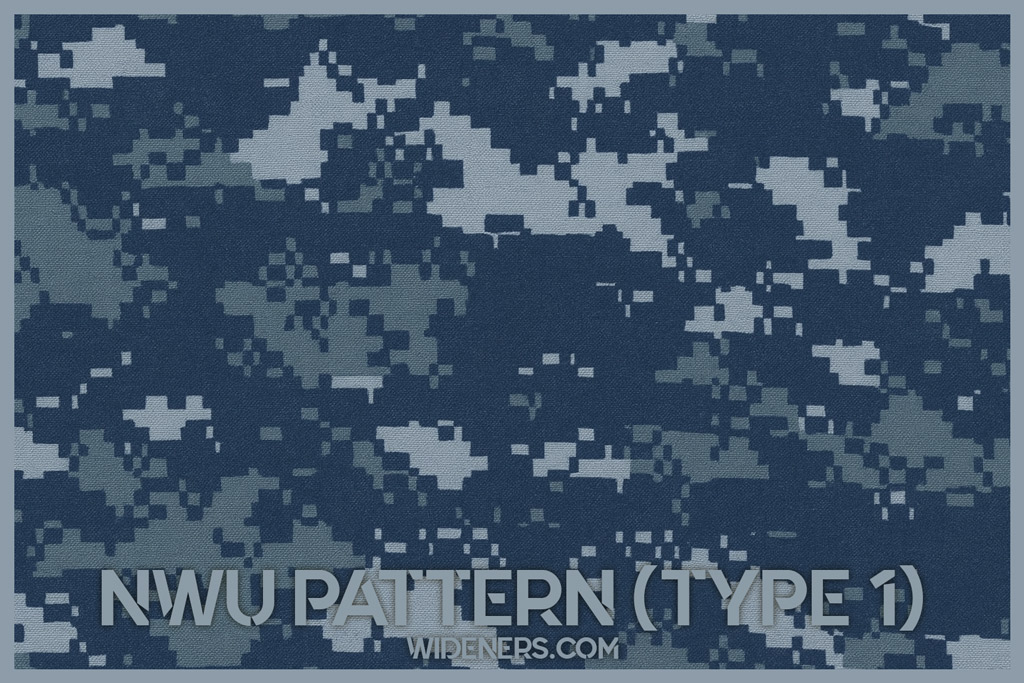
The United States Navy utilizes the NWU pattern in a variety of different color pallets.
The Navy has several camouflage patterns, which is not surprising, given its diverse range of missions and varied operational terrain. The United States Navy wears a base camouflage pattern that features a pixelated design common to many military branches. Still, it has its own color scheme that helps it stand out from the rest.
What is the US Navy Camo Pattern?
The uniform of the United States Navy is the NWU, also known as the Naval Working Uniform. Due to the Navy’s diverse theaters and broad needs, several Navy patterns carry the NWU designation. These patterns include NWU 1, NWU 2, and NWU 3. The NWU 1 is no longer in service.
The NWU 2 camo pattern, also known as AOR1, consists of desert tones, including a mix of beige and soft browns. This pattern is worn by specific branches within the Navy and is not standard among all personnel on duty.
The standard camouflage pattern is NWU 3. This pattern features more woodland tones, including greens and a speckling of dark brownish-black. The NWU 3 is now the standard Navy uniform. It replaced the flawed (though somewhat iconic) NWU 1 around 2019, when the NWU 1 was completely phased out.
Why Did the Navy Drop the NWU 1?
The NWU 1 was also known as “aqua-flage”, which means water camouflage. Intended as a homage to the history of the navy, the design used shades of dark blue and grey, creating a somewhat watery effect. The pattern is also called “blueberry” because it resembles a cluster of blueberries.
Why did the Navy discard it? One of the main reasons was its subpar flame-resistance. This is especially true for work on a boat, where fire control is much more important than many people realize. If a service member caught on fire, the fabric on the NWU 1 would stick to them, worsening the burn and making it more difficult to care for the victim.
Military Camouflage Pattern: The US Air Force
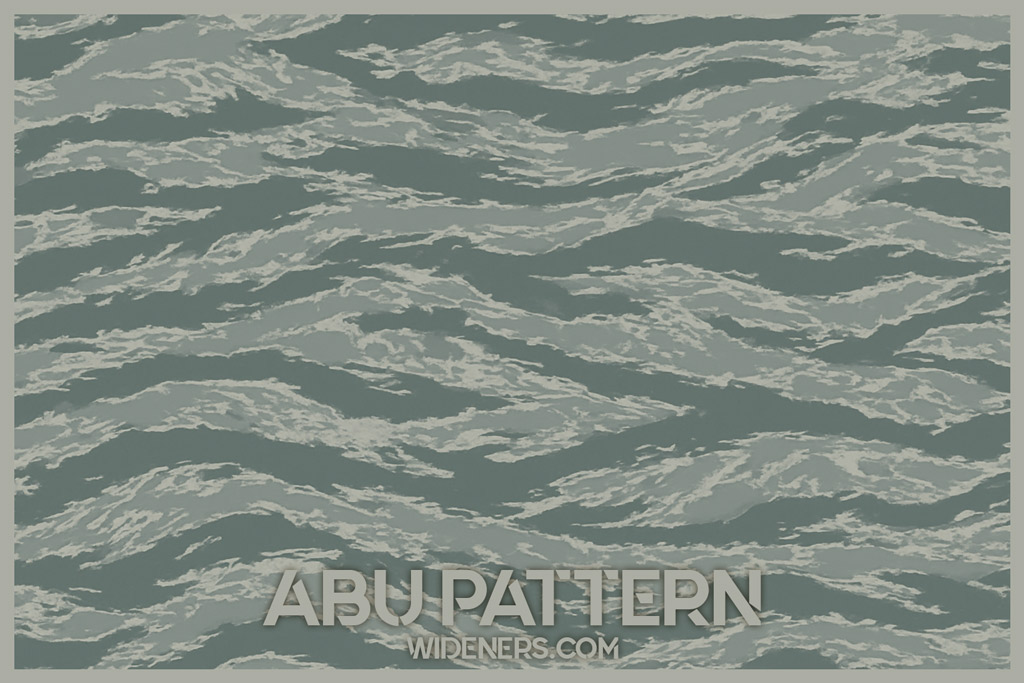
Although they now use the OCP pattern, the US Air Force used the popular ABU “tiger stripe” from 2007 to 2021.
The United States Air Force now uses a camouflage pattern similar to those of the US Army and the Space Force—the Operational Camouflage Pattern (OCP).
Currently, there are no serious design differences between this pattern as worn by the Army, Space Force, or Air Force. This may change in the future, but for now, it proves the popularity and effectiveness of OCP uniforms.
The Air Force fully adopted the OCP around 2018, when the Airman Battle Uniform (ABU) was phased out. By 2021, most members of the Air Force had adopted the OCP. The ABU was an interesting uniform because it incorporates the Tiger Stripe pattern.
What is the Tiger Stripe Camo Pattern?
This design resembles the stripes on the side of a Tiger. Of course, instead of orange, the Tiger Stripe pattern typically appears in traditional military colors, such as woodland greens and browns, or desert grays.
The Tiger Stripe pattern was popularized during the Vietnam War era, and its design has endured to this day. Even though there are not many US forces still using this design, it’s still seen around the world in some capacities, being more popular in jungle settings (which is why it may have caught on in Vietnam in the first place).
US Space Force Camouflage Pattern
The United States Space Force was founded in 2019. Of all the military branches discussed in this article, this is the newest. The Space Force is closely related to the Air Force, which is why the camouflage they wear is quite similar to that of the Air Force. It consists of the Operational Camouflage Pattern (OCP), the only camo pattern currently popular among the Space Force. It consists of the same beige, green, and brown as the Army and the Air Force.
Why Does Space Force Even Wear Camouflage?
Some question why the Space Force wears uniforms so similar to the Army and Air Force. It’s not like there are forests in space. Are they trying to hide from extraterrestrial life? While these questions are somewhat humorous, there are very good reasons for the Space Force to have a camouflage uniform.
First, for the sake of tradition. Camo has become a staple of the Armed Forces. When you see someone wearing camouflage, you immediately recognize them as a member of the United States military. This has numerous advantages, particularly in large-scale operations.
Second, even though members of the Space Force are not typically specialists in the forests and jungles of the world, that doesn’t mean they never need to enter those places. Branches of the military frequently collaborate, work together, and share resources. It’s very possible that a member of the Space Force will find themselves in an environment where they’ll need to be concealed. It’ll also be interesting to see if the Space Force becomes more distinct from the Air Force and begins to create their own camouflage pattern.
While we’re still far from setting up military bases on Mars, it’s a good guess that once the Space Force gets there, they’ll want to incorporate rusty orange into their camo palette.
Special Operations Military Camouflage Patterns: Navy SEAL Camo, Army Rangers, and Pararescue
The Special Operators of the United States Military do not fall under a single branch. Instead, it’s comprised of operators from several branches. There are many prestigious military units within the United States Military (some, no doubt, not publicly known). However, for the purposes of this article, we’ll focus on the most notable ones.
What Military Camouflage Patterns do the Navy SEALs Wear?
Navy SEALS will wear whatever form of camouflage they need to complete their mission. Their daily uniform will often consist of some kind of Multi-Cam pattern, as seen in the NWU 2 uniform.
What Camo Pattern Does Delta Force Wear?
While the Delta Force does not widely disseminate information about their uniforms, they will wear camo similar to the Army’s OCP, consisting of green, brown, and light tan colors.
What Camo Pattern Do Air Force Special Forces Wear?
Air Force Special Forces members wear camouflage patterns similar to the OCP worn by Air Force personnel. Often, the camo pattern features a base of tan color with accents of green and sand.
One reason descriptions of Special Operator Camo can be a little vague is that the Special Forces don’t have the same interest in being recognized as other members of the military.
Many Special Forces missions require service members to be completely unrecognized. This may lead them to wear several camouflage patterns, plain clothes, or even a ghillie suit. The ghillie suit incorporates leaves and branches, making the wearer almost completely unrecognizable when done correctly.
For the Special Forces, their distinguishers are more likely to be pins or patches, such as the Trident worn by US Navy SEALS. SOF units often have the freedom to dress in whatever garb their mission demands.
If you’re curious to learn more about the special forces, have a look at the history of SOCOM.
Why Are There So Many US Military Camouflage Patterns?
Navigating the number of camouflage patterns used by the US military can be confusing, but they all serve a purpose.
The United States Military has been experimenting with various modern camouflage patterns since the 1940s. There were more diverse camouflage patterns in the 1990s, when military units were experimenting with various designs. However, in the last couple of years, many branches of the armed forces have adopted a single type of camo—the Operational Camouflage Pattern (OCP).
The United States Army uses the Operational Camouflage Pattern, as do many of its special forces, such as the Rangers. The Air Force and the Space Force also use the OCP, switching from a Tiger Stripe design that had been popular with the Air Force for about a decade.
The Marines are different, sticking with MARPAT, which is heavily based on digital camouflage or pixelated patterns. The Navy wears a multi-cam pattern that combines some of the digital aspects of the Marines with its own unique colors and designs.
The camouflage of the United States Special Forces is more difficult to pin down. Their base camouflage is similar to the branch from which they originate, while the Navy SEALs wear a pattern that closely matches the Multi-Cam design of the NWU. However, it’s impossible to know the kind of camouflage special ops members wear when conducting missions to keep the country safe.
Now that you’re something of an expert on the different types of US Military Camouflage, be sure to check out this article on the exciting history of West Point.
You may also like