


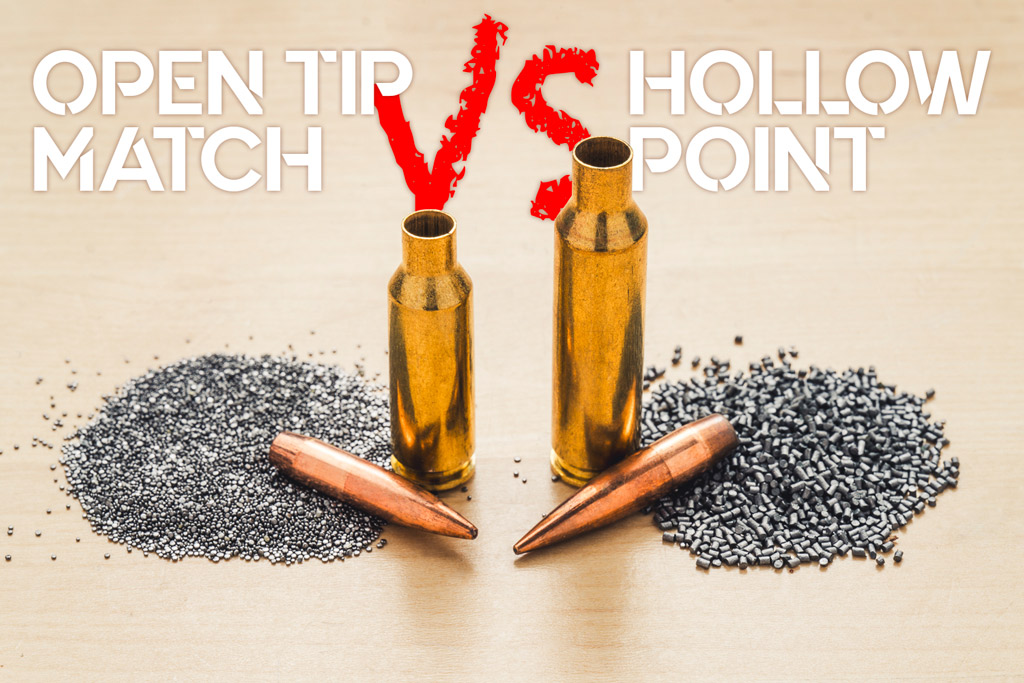
Ammunition design has developed alongside firearms technology, producing specialized bullet types optimized for very different goals. Two designs are often confused: Open Tip Match vs. hollow-point, because they look similar at a glance. Both feature an opening at the nose, yet their engineering intent, performance characteristics, and best applications differ considerably.
This article covers each type of bullet in detail, including its history, design, strengths, weaknesses, and common myths.
What Is an Open Tip Match (OTM) Bullet?
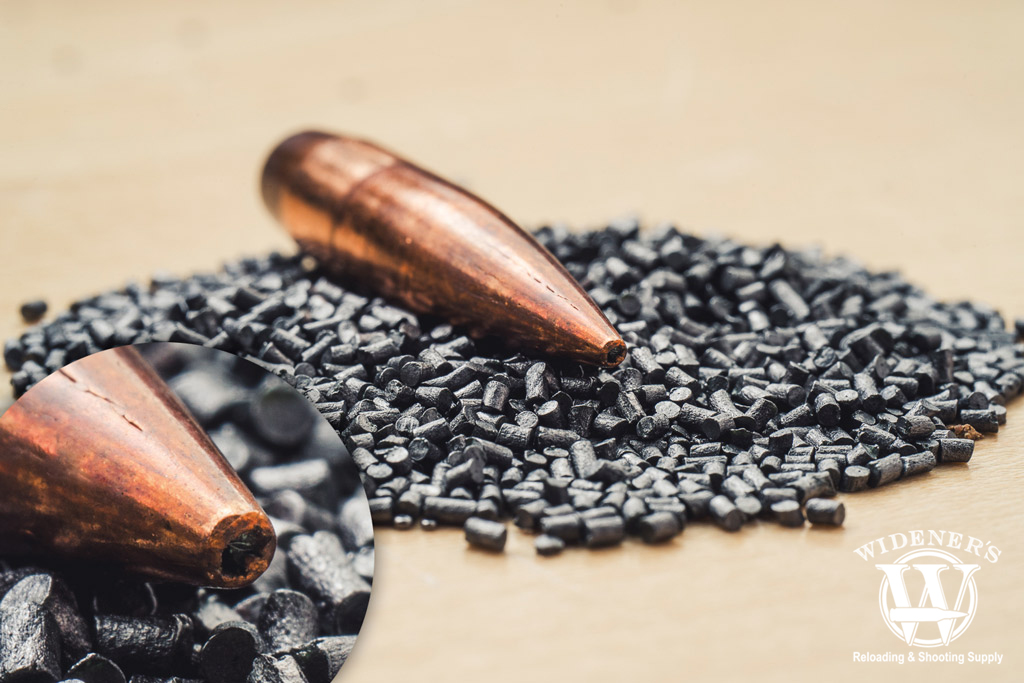
Open Tip Match (OTM) bullets are designed for ballistic consistency and accuracy, not expansion.
An Open Tip Match (OTM) bullet is a precision projectile designed primarily for accuracy and ballistic consistency, not expansion.
The opening at the tip is a manufacturing artifact created when the jacket is drawn from the base and closed at the nose after the lead core is inserted.
Because the opening is extremely small, often only 0.5–1 mm, it typically does not expand reliably in soft targets.
Key Characteristics
- Engineered for exactness and uniformity
- Small tip opening created by the manufacturing process
- High ballistic coefficient and excellent flight stability
- Not designed primarily for expansion
- Commonly used in match and long-range ammunition
OTM bullets are often considered similar to full-metal-jacket designs in their terminal behavior, despite their open-tip appearance.
History of OTM Bullets
OTM bullets originated in competitive shooting and military precision programs. An important milestone occurred when match bullets with tiny tip openings were evaluated for military use in the 1980s.
Legal reviews concluded that these bullets did not violate expanding-bullet prohibitions because the openings were not intended to cause expansion. This led to the adoption of OTM match bullets for military sniper ammunition.
Modern military precision cartridges, such as certain sniper loads, still employ OTM bullets because of their exceptional accuracy and flight stability.
What is a Hollow Point Bullet?
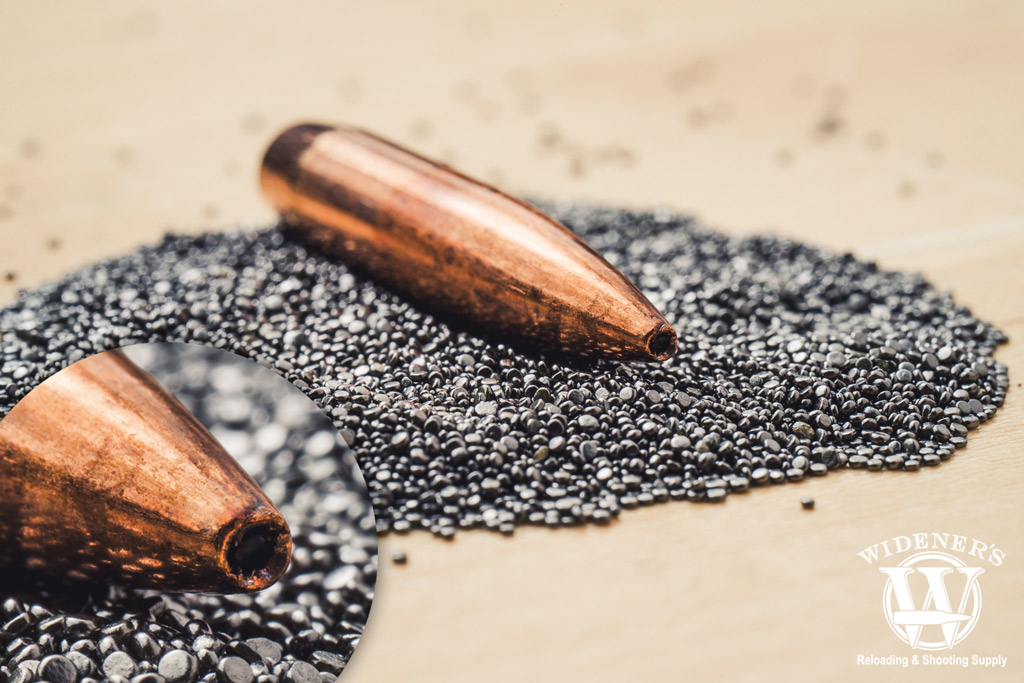
Hollow point (HP) bullets have a hole in the tip that expands when they hit soft tissue.
A hollow point is an expanding bullet with a hole in the tip that deforms in a controlled way when it hits soft tissue. When the bullet hits something, hydraulic pressure pushes the nose out, making a mushroom-shaped expansion that increases surface area and energy transfer.
Important features
- Made just for growth
- Better transfer of energy
- Less chance of going too deep
- The wound channel is bigger than with bullets that don’t expand
- Often jacketed (JHP) with cuts that are made to make it weaker and help it expand
The History of Hollow Point Bullets
Hollow-point concepts date back to the late 19th century, when early “express” bullets were hollowed out to reduce mass and increase velocity. Designers soon discovered that the cavity also enhanced expansion, causing improved terminal effectiveness.
As smokeless powder increased bullet velocity, jacketed hollow points emerged to sustain structural integrity while still expanding. Though prohibited for military warfare by the Hague Convention due to concerns about excessive wounding, hollow points became widely adopted by hunters, law enforcement, and civilians.
Design Differences: Open Tip Match VS Hollow Point
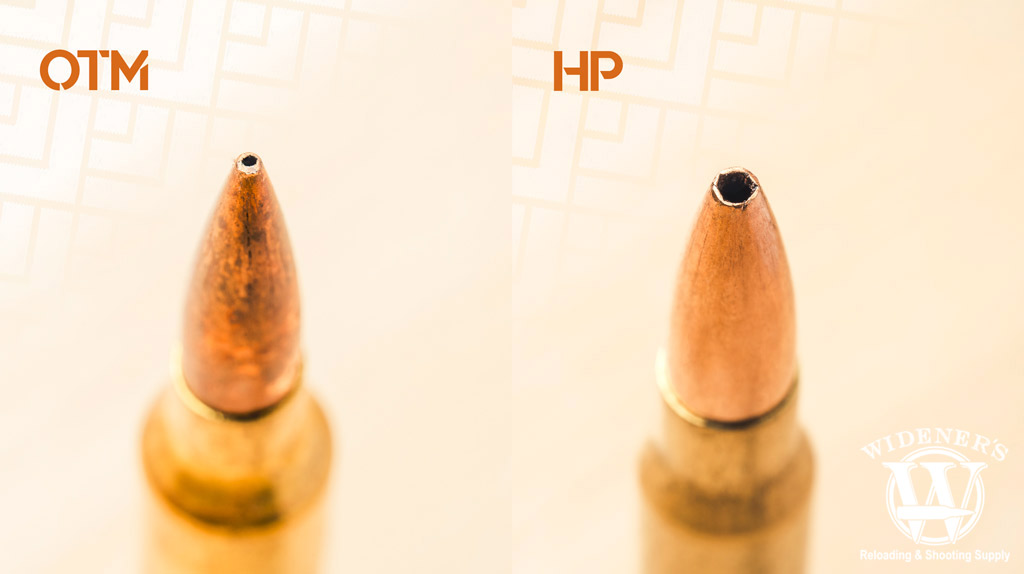
The opening on the nose cone of an OTM bullet (Left) is smaller than the opening on a hollow point (Right).
OTM and hollow-point bullets both have visible nose openings, but their internal designs and functions differ significantly.
Design of a Hollow Point
- A big cavity was made intentionally to allow for growth
- Scoring or thinning the jacket to help it mushroom
- Performance at the end is most important
Design of OTM
- Small tip opening left over from manufacturing
- Core put in from the bottom for perfect weight distribution
- Consistency and aerodynamics come first
It’s important to know the difference: the cavity of a hollow point is a useful feature, while the opening of an OTM is more incidental.
Performance Characteristics
Each cartridge type has different performance characteristics that stem from its design. We list the main divergences below.
How Hollow Points Work
Hollow points are very good at killing. Expansion increases the tissue’s resistance to drag, thereby accelerating energy transfer and reducing penetration depth. This makes them good for self-defense and hunting, where you want to be able to stop at a set speed.
Pros:
- Expansion that works
- Less chance of going too far
- Very good at stopping
- Ethical hunting performance
Limitations:
- Less penetration through barriers
- Occasionally, some guns have less reliable feeding
- The ballistic coefficient is usually lower than that of match bullets
How OTM Bullets Work
OTM bullets are excellent for target shooting. Their manufacturing process ensures that the mass is evenly distributed and that the shape is aerodynamically stable, improving stability and accuracy over long distances.
Pros:
- Very accurate
- High ballistic coefficient
- Flight performance is consistent
- Commonly used in sniper and precision competitions
Limitations:
- Expansion isn’t as reliable
- Terminal performance is less predictable
- Not as good for defense or hunting roles
Best Uses: Open Tip Match VS Hollow Point

Open Tip Match VS Hollow Point: Hollow points (Top) are generally used for hunting; OTM bullets (Bottom) are used for precision applications.
Hollow Point Best Uses
- Self-defense and duty ammunition
- Law enforcement applications
- Hunting medium-sized game
- Situations requiring controlled penetration
OTM Best Uses
- Precision rifle competitions
- Long-range shooting
- Military sniper applications
- Ballistic testing and load development
While OTMs may occasionally be used for hunting or defensive purposes, they are not purpose-built for those roles.
Key Differences: Open Tip Match VS Hollow Point
| Feature | Hollow Point | OTM |
| Primary Purpose | Expansion and terminal performance | Precision and accuracy |
| Tip Opening | Large functional cavity | Small manufacturing artifact |
| Expansion | Reliable and engineered | Typically minimal or inconsistent |
| Accuracy Focus | Secondary | Primary |
| Typical Uses | Self-defense, hunting | Match shooting, sniping |
| Penetration | Controlled | Often deeper and less predictable |
Common Misconceptions About OTM vs Hollow Point Ammo
Misconception #1: OTM bullets are not solid points
This is the most common mistake. OTMs look similar, but they are not meant to expand. The tip opening is there because of how they are made, not because of how they are designed.
Misconception #2: OTMs are illegal bullets that expand in war
A military legal review found that OTMs are not unlawful as expanding bullets because they are designed to be accurate, not to cause more damage.
Misconception #3: Hollow points are always more accurate
Some hollow-point designs can be accurate, but match-grade OTM bullets are usually better for precision shooting because they have tighter manufacturing tolerances and more consistent weight distribution.
Misconception #4: OTMs can’t cause terminal effects
OTM bullets can still break apart or yaw, depending on how fast they are going and how hard they hit something, but these effects are not what the design is meant to do and are less predictable.
Open Tip Match VS Hollow Point: Additional Considerations
The intended use of the bullets should help you choose the right ones.
Pick Hollow Points When:
- The effectiveness of the terminal is important
- Less overpenetration is better
- Hunting or defensive situations are the main ones
Pick OTM When:
- Consistency and accuracy are important
- Long-range ballistic performance is very important
- The goal is either competition or training
Understanding these differences helps shooters choose the right ammo and improve their experiences.
Case Closed: Open Tip Match VS Hollow Point

Understanding the differences between OTM & HP bullets allows shooters to choose the right bullet type for their needs.
Open Tip Match and hollow point bullets represent two distinct philosophies in projectile design. Hollow points focus on controlled expansion and terminal effectiveness, rendering them ideal for defensive and hunting roles. In contrast, OTM bullets stress precision and ballistic consistency, excelling in competition and long-range shooting.
The confusion between these bullet types derives from their visual similarity, yet their engineering intent differs fundamentally. Recognizing this difference allows shooters to choose the right ammunition for their needs, avoid misconceptions, and better understand ballistic performance.
You may also like
