

The price of guns and ammo has always been unstable. Inflation, political changes, new laws, international conflicts, supply chain issues, and changing public opinion on gun ownership all contribute to this volatility. As Ecclesiastes 1:9 says, there’s nothing new under the sun.
In some ways, the story is surprising. While the prices of most goods, such as homes, cars, and fuel, have skyrocketed, some types of ammunition have actually become more affordable in real terms. At the same time, firearms themselves have seen significant price increases, often caused by regulation, higher demand, and manufacturing changes.
Let’s take a closer look at the changes and economic factors behind the pricing to understand the full story.
The Big Picture: Then vs. Now
Before diving into firearms specifically, it’s important to understand the broader economic backdrop.
1986 vs 2026: Cost of Living Comparison
Median Household Income
- 1986: $24,900
- 2026: $84,000 (Projected)
Cost of the Average New Home
- 1986: $111,900
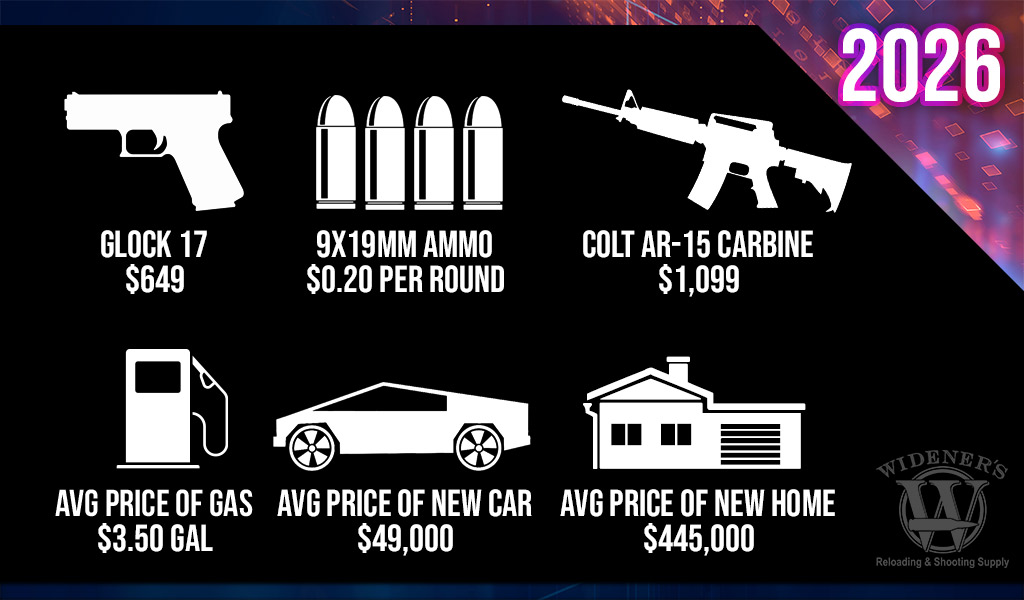
- 2026: $445,000
Price of the Average Used Home
- 1986: $92,000
- 2026: $398,000
Average New Car Costs
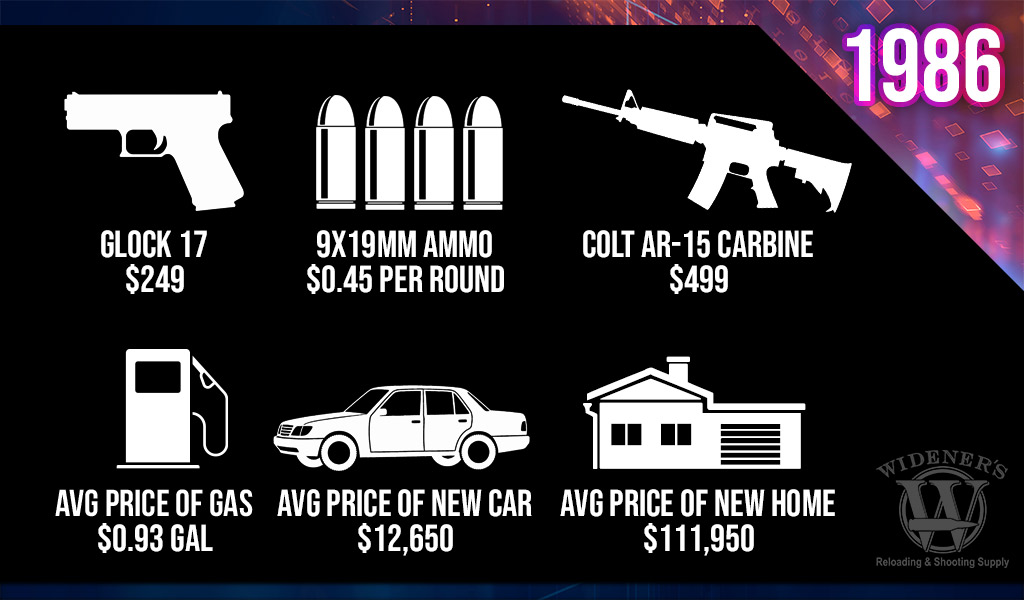
- 1986: $12,650
- 2026: $49,000
Price of Gas (Per Gallon)
- 1986: $0.93
- 2026: $3.50
At a glance, most major life expenses have increased roughly 3x to 4x over 40 years. This sets a baseline expectation: if guns and ammo followed the same trend, we’d expect similar increases.
But they didn’t, at least not evenly across the board.
The 1980s: A Different America for Gun Owners
Handgun ammo prices were higher in the 1980’s due to lower volume and demand.
To fully understand firearm and ammunition pricing in 1986, you have to look beyond the numbers and into the broader cultural and economic environment of the 1980s.
This was a fundamentally different era, both politically and culturally, especially when it came to guns.
A Strong Economy with Different Priorities
Under President Ronald Reagan, the 1980s were a time of economic growth, lower inflation, and higher consumer confidence after the 1970s were a time of trouble.
Some important things about the decade were:
- Lower cost of living in general
- Wages were going up compared to the cost of living
- The U.S. economy had higher manufacturing
- Supply chains were less globalized
People who bought guns more often saw them as useful tools rather than risky or politically charged purchases.
Gun Culture in the 1980s
In 1986, gun ownership looked very different from what it does today.
The typical firearm owner was:
- A hunter
- A rural homeowner
- And/or a recreational shooter
Self-defense was part of the equation, but it wasn’t nearly as dominant as it is today.
Popular firearm categories reflected this:
- Revolvers like the S&W Model 19
- Bolt-action rifles like the Remington 700
- Shotguns like the Remington 870
Semi-automatic pistols, like the Glock 17, were just gaining traction in the U.S. market.
The Rise of the “Wonder Nine”

The “Wonder 9” Glock 17 began entering the U.S. consumer market in 1986.
The mid-1980s marked the early adoption of high-capacity 9mm pistols, often called “Wonder Nines.”
The introduction of the Glock 17 into the U.S. market was particularly significant:
- Polymer frame construction (revolutionary at the time)
- Higher magazine capacity than revolvers
- Lower manufacturing cost
Law enforcement agencies began transitioning away from revolvers, a shift that would later drive massive civilian demand for 9mm pistols and ammunition.
This shift is one of the key reasons why 9mm ammo became so dominant (and eventually so affordable) by 2026.
Regulation Was Present, But Less Visible
Although gun laws existed in 1986, they weren’t as central to public discourse as they are today.
The passage of the Firearm Owners’ Protection Act (FOPA) reflected a moment where:
- Gun owners pushed back against federal enforcement practices.
- Lawmakers sought to clarify and standardize regulations.
At the same time, the Hughes Amendment quietly introduced one of the most significant long-term pricing distortions in firearms history by freezing the supply of transferable machine guns.
No Internet, No Instant Panic Buying

In the 1980’s, you could buy guns and ammo in stores, over the phone, or by mail order.
One of the biggest differences between 1986 and 2026 is how fast information, and fear, spread.
In the 1980s, there were:
- No online retailers
- No social media
- No real-time news cycle
As a result:
- Buying patterns were more stable
- Shortages were less frequent
- Prices were less volatile
Contrast that with today’s market, where a single news event can trigger nationwide demand spikes within hours.
Ammo Was Expensive Because Volume Was Lower
Another overlooked factor is that ammunition production in the 1980s was far less optimized than it is today. There were:
- Fewer large-scale production facilities
- Less automation
- Lower civilian consumption of high-volume calibers
Economies of scale didn’t exist in the same way they do now.
Why the 1980s Still Matter Today
The 1980s laid the groundwork for many of today’s firearm market dynamics:
- The shift from revolvers to semi-autos
- The rise of the 9mm as the dominant caliber
- The regulatory framework shaped by FOPA
- The early stages of modern firearm manufacturing
Understanding this era helps explain why some prices rose steadily, others stagnated, and a few, like 9mm ammo, actually dropped over time.
Firearm Prices: How Much Have Guns Increased?
Firearm prices have generally increased over time, but not always at the same pace as housing or vehicles. Here’s a direct comparison of some popular models:
Gun Price Comparison (1986 vs 2026)
| Firearm Type | 1986 Price | 2026 Price |
| Glock 17 | $249 | $649 |
| Colt 1911 | $499 | $1,199 |
| S&W Model 19 | $349 | $1,119 |
| Ruger 10/22 | $79 | $349 |
| Colt AR-15 Carbine | $499 | $1,099 |
| Remington 700 | $179 | $499 |
| Remington 870 Shotgun | $149 | $499 |
What This Tells Us
Most firearms increased between 2x and 4x, which roughly tracks inflation and general consumer goods trends. However, some models, particularly revolvers and classic designs, have increased more sharply due to:
- Collector demand
- Reduced production volumes
- Higher labor costs
- Premium brand positioning
Semi-automatic rifles like the AR-15 platform have remained comparatively accessible, largely due to mass production and market competition in the modern era.
Ammo Prices: A Very Different Story
Unlike firearms, ammunition pricing tells a much more complex (and surprising) story.
Ammo Price Comparison (1986 vs 2026)
| Ammo Type | 1986 | 2026 |
| 12-Gauge 00 Buck (25 Shells) | $4.00 | $19.99 |
| .22LR (100 rounds) | $5.49 | $13.99 |
| .223 Rem (20 rounds) | $11.99 | $12.99 |
| .308 Win (20 rounds) | $15.99 | $19.99 |
| 9mm (50 rounds) | $22.50 | $10.00 |
| .38 Special (50 rounds) | $16.99 | $28.99 |
| .45 ACP (50rounds) | $12.99 | $22.99 |
The Biggest Surprise: 9mm Got Much Cheaper
In 1986, a box of 9mm cost $22.50, or about $0.45 per round.
In 2026, it averages $10.00 per box, or $0.20 per round.
Even without adjusting for inflation, that’s a dramatic decrease. When adjusted for inflation, 9mm is significantly cheaper today than it was in the 1980s.
Why Did Ammo Prices Diverge?
Several key factors have influenced the price of guns and ammo:
- Globalized manufacturing
- Improved production efficiency
- Mass civilian adoption of certain calibers (especially 9mm)
- Military and law enforcement standardization
At the same time, less common calibers (.38 Special, .45 ACP) have become relatively more expensive due to lower production volume and niche demand.
The 1986 Turning Point: Firearm Owners’ Protection Act

In 1986, the Hughes Amendment banned civilian ownership of newly manufactured fully automatic firearms.
One of the most important legislative milestones affecting firearm pricing was the Firearm Owners’ Protection Act (FOPA), signed into law in 1986.
What FOPA Did
FOPA was designed to protect gun owners from overly aggressive enforcement of federal gun laws. It:
- Limited ATF inspection powers
- Protected interstate firearm transport
- Clarified definitions for dealers vs private sellers
However, it also included a critical last-minute amendment:
The Hughes Amendment
The Hughes Amendment banned civilian ownership of newly manufactured fully automatic firearms after May 19, 1986.
Impact on the Price of Guns and Ammo
The Hughes Amendment created a fixed supply of transferable machine guns, which led to explosive price increases over time.
While this didn’t directly affect semi-automatic firearms like AR-15s, it demonstrated how regulation can instantly reshape market pricing.
The 1994 Assault Weapons Ban & Its Aftermath
Another major event was the Federal Assault Weapons Ban, which was in effect until 2004.
Key Effects
- Restricted certain rifle features (flash suppressors, collapsible stocks, etc.)
- Limited magazine capacity to 10 rounds
- Created a divide between “pre-ban” and “post-ban” firearms
Impact on the Price of Guns and Ammo
- “Pre-ban” rifles and magazines skyrocketed in value
- Manufacturers adapted by producing compliant models
- After its expiration in 2004, prices normalized, and supply increased
This period showed how temporary legislation can create artificial scarcity and price volatility
Panic Buying & Political Cycles (2008–2024)
The Consumer Price Index (CPI-U) records that U.S. prices have risen by roughly 200% since 1986.
From the late 2000s onward, firearm and ammo prices became increasingly tied to political events.
Key Demand Surges
- 2008 Election of Barack Obama
- 2012 Sandy Hook shooting
- The 2020 COVID-19 pandemic and civil unrest
- 2020–2021 election cycle
Each of these events triggered waves of:
- Panic buying
- Ammo shortages
- Price spikes
During peak shortages, 9mm prices temporarily ranged from $0.80 to $1.00 per round, far above historical norms.
Long-Term Effects
While prices eventually stabilized, these cycles:
- Increased baseline demand
- Expanded the gun-owning population
- Encouraged stockpiling behavior
It’s easy to see why firearm prices have remained elevated even after the supply recovered.
Manufacturing Evolution: Why Some Guns Stayed Affordable
Modern firearm manufacturing has changed dramatically since 1986.
Key Advancements
- CNC machining and automation
- Polymer frame technology (popularized by Glock)
- Modular platforms like the AR-15
- Global sourcing of components
These innovations allowed manufacturers to:
- Reduce costs
- Increase output
- Maintain competitive pricing
This is the main reason why rifles like the AR-15 remain widely available and relatively affordable compared to other goods.
Cultural Shifts in Gun Ownership

A major shift in American gun culture happened in the 2000’s with the demographics of gun owners changing.
In 2026, owning a gun is very different from owning one in 1986.
Then (1986):
- Mostly hunters and hobbyists who shoot for fun
- Revolvers and bolt-action rifles were the most common
- Localized trap & skeet shooting clubs
- Laws about carrying guns in public were limited
Now (2026)
- More people are buying guns for the first time
- More states are allowing concealed carry
- People are increasingly interested in guns for personal defense
- More people are getting into competitive shooting sports
The move toward self-defense and everyday carry has led to a huge demand for:
- Small handguns
- 9mm bullets
- Training and accessories
The high demand for 9mm ammo is one of the main reasons it has gotten cheaper.
Real Affordability: Are Guns Cheaper or More Expensive Today?
When you compare raw prices, guns are clearly more expensive in 2026. But affordability depends on context.
Gun Example: Glock 17
- 1986: $249
- 2026: $649
That’s about a 2.6x increase, while home prices increased nearly 4x.
Ammo Example: 9mm
- 1986: $0.45/round
- 2026: $0.20/round
That’s quite a decrease in nominal cost, and an even larger drop when adjusted for inflation.
Recap on the Price of Guns and Ammo
- Firearms: Moderately more expensive, but roughly in line with inflation
- Ammo (common calibers): Often cheaper than ever
- Ammo (less common calibers): More expensive due to lower demand
Final Thoughts: 40 Years of Change
The evolution of gun and ammo prices from 1986 to 2026 reflects more than just inflation; it tells a story about legislation, culture, and technology.
Historical Takeaways:
- The Firearm Owners’ Protection Act permanently reshaped parts of the firearms market
- Political events and media cycles have driven repeated demand spikes
- Technological advancements have kept some firearms affordable
- Mass adoption of 9mm has made it cheaper than ever
Perhaps the most interesting guns and ammo takeaway is this:
While nearly everything else in life has become dramatically more expensive, shooting, at least with common calibers, has become more accessible in many ways.
At the same time, regulatory pressure and cultural shifts ensure that firearm pricing will remain sensitive to political and social forces for years to come.