
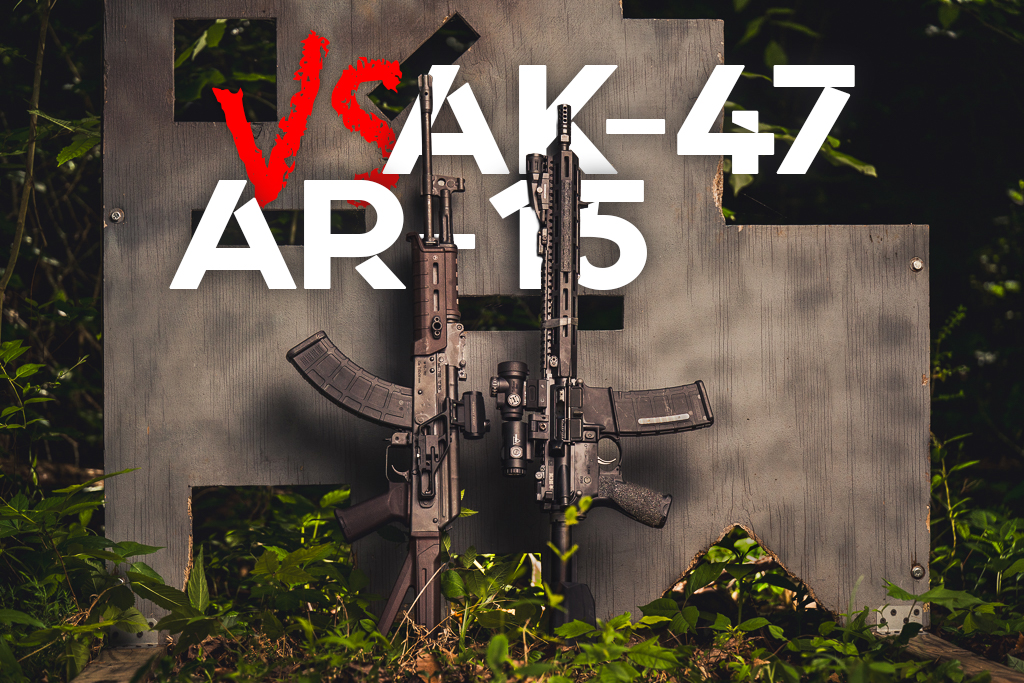
The AK-47 vs. AR-15 debate is the most hotly contested pop culture battle between the U.S. and Russia since Rocky Balboa took on Ivan Drago. Alright, maybe that’s a bit of an exaggeration. Still, gun owners can be dogmatic when it comes to the AK-47 vs. AR-15 conversation.
After all, the AK-47 and the AR-15 are two of the most recognizable rifles in the world. Both were born from mid-20th-century military needs and have since become popular among civilian shooters. In the United States, the AR-15 is sometimes called “America’s Rifle,” while the AK-47 is globally renowned for its rugged simplicity.
History & Background: AK-47 vs AR-15
Our AK-47 vs. AR-15 head-to-head tells you everything you need to know when choosing one to add to your collection. For most collectors, the answer is obvious. Both. However, let’s start at the beginning and take a look at the storied history of both firearms.
The AK-47: A Brief History
The AK-47 (Avtomat Kalashnikova 1947) was developed in the late 1940s by Soviet tank mechanic-turned-designer Mikhail Kalashnikov. It was officially adopted by the Soviet Union in 1947, giving the rifle its namesake year. The AK-47 was designed to be a durable, easy-to-produce infantry rifle chambered for the intermediate 7.62×39mm cartridge.
It quickly proved reliable and effective, and over the ensuing decades, it became the most produced firearm in history (with an estimated 100 million-plus in the Kalashnikov family worldwide). The rifle’s simple construction—stamped metal parts and a robust gas-piston system—made it ideal for mass production and use by conscript armies and guerrilla fighters alike.
The AR-15: A Brief History
The AR-15 (ArmaLite Rifle 15) was developed about a decade after the AK. In the late 1950s, American engineer Eugene Stoner at ArmaLite designed the AR-15 as a lighter, smaller-caliber companion to his 7.62mm AR-10. ArmaLite sold the design to Colt, and the U.S. military eventually adopted the rifle (chambered in .223 Remington/5.56×45mm) in the 1960s as the select-fire M16.
The civilian Colt AR-15 semi-automatic model was marketed in the 1960s, and today, “AR-15” commonly refers to any semi-automatic rifle built on that platform by various manufacturers. The AR-15 platform is lightweight and made extensively of aluminum and polymer, a stark contrast to the wood and steel of the AK.
Caliber & Ballistics: AK-47 vs AR-15
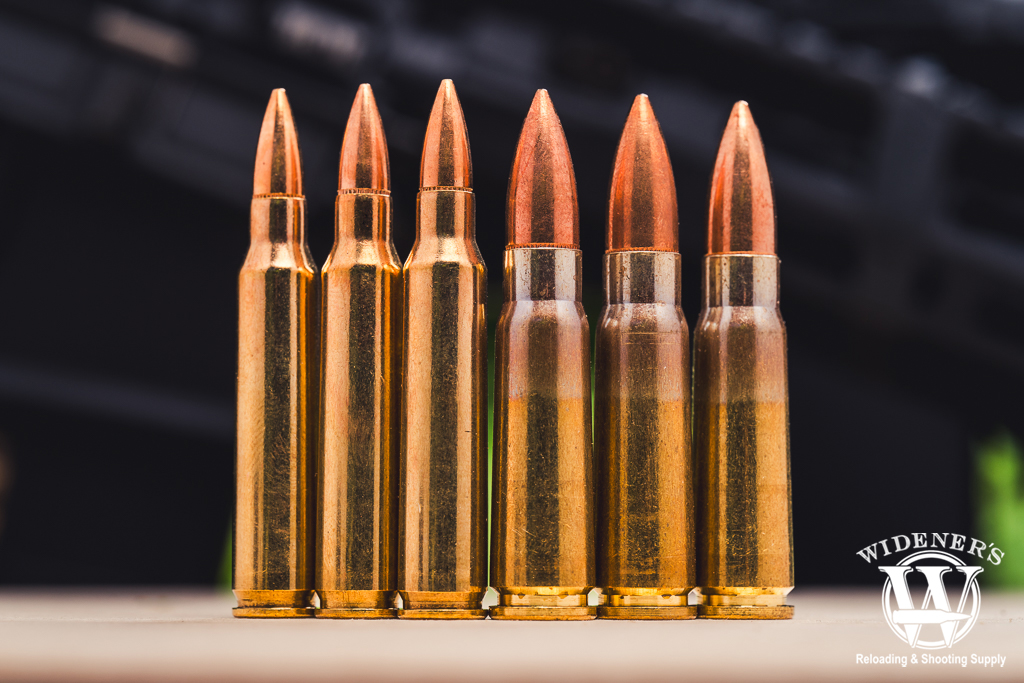
The 7.62×39 (Right) transfers more energy into targets, while the 5.56×45 (Left) has higher velocities.
One of the biggest differences between the AK-47 and AR-15 is the ammunition they fire. The AK-47 is chambered for 7.62×39mm, a Soviet intermediate cartridge firing a relatively heavy 122–125 grain bullet. The AR-15 is typically chambered in .223 Remington/5.56×45mm NATO, a smaller caliber U.S. cartridge firing a lighter 55–62 grain bullet (in standard loadings). These cartridges have distinct characteristics affecting the rifles’ range, recoil, and role.
Ballistic Comparison (7.62×39 vs 5.56×45)
| Cartridge Specs | 7.62x39mm | .223 Remington |
|---|---|---|
| Parent Casing | N/A | .222 Remington |
| Bullet Diameter | .309″ | .224″ |
| Neck Diameter | .339″ | .253″ |
| Base Diameter | .447″ | .376″ |
| Case Length | 1.52″ | 1.76″ |
| Overall Length | 2.20″ | 2.26″ |
| Grain Weight | 112gr-180gr | 36gr-77gr |
| Max Pressure (SAMMI) | 45,010 PSI | 55,000 PSI |
The AK’s 7.62×39 is a larger-diameter, heavier bullet that moves at a moderate velocity, whereas the AR’s 5.56×45 is a smaller, lighter projectile with a high velocity. For example, a typical 7.62×39 round (123gr) has a muzzle velocity around 2,300–2,400 feet per second, while a standard 5.56 NATO round (55gr) can reach ~3,000+ fps from a 16″ barrel.
This higher velocity gives the 5.56 a flatter trajectory and longer effective range. Generally, the AR-15’s 5.56mm round is effective to roughly 500–600 meters, whereas the AK-47’s 7.62×39 is effective to about 300–400 meters. In other words, the AR-15 can reliably engage targets at longer distances than the AK-47 under comparable conditions.
The 7.62×39 does hit harder at close ranges. It carries more kinetic energy at the muzzle – roughly 1,500–1,600 ft-lbs vs about 1,200–1,300 ft-lbs for 5.56. This translates to strong “stopping power” at short range. However, because the 7.62mm bullet is fairly blunt and heavy, it loses velocity faster over distance due to aerodynamic drag.
The lighter 5.56mm round retains velocity better at a few hundred yards out, and the energy gap closes. In fact, at about 300m, the two rounds have nearly equal remaining energy; beyond that, the 5.56 may have the advantage in penetration and trajectory. The 5.56’s higher speed also tends to cause more fragmentation in soft targets at close range, whereas the 7.62 relies more on sheer caliber and momentum.
Recoil & Control
The AK-47’s larger round produces more recoil than the AR-15. Users often describe the AK’s recoil as a firm “push.” This is very manageable in semi-automatic, but muzzle rise can be noticeable in rapid fire. The AK-47’s recoil is roughly twice that of a 5.56 AR, which can slow down successive shots for an average shooter.
The AR-15 has a relatively light recoil and muzzle climb, allowing shooters to fire quick follow-up shots with ease. The AR’s recoil is so mild that staying on target, even during rapid semi-auto fire, is quite easy for most shooters (one reason it’s favored in competitions).
Still, both rifles are considered moderate-recoil firearms; even newer or smaller-framed shooters can learn to manage either with some practice.
Design, Reliability, & Maintenance
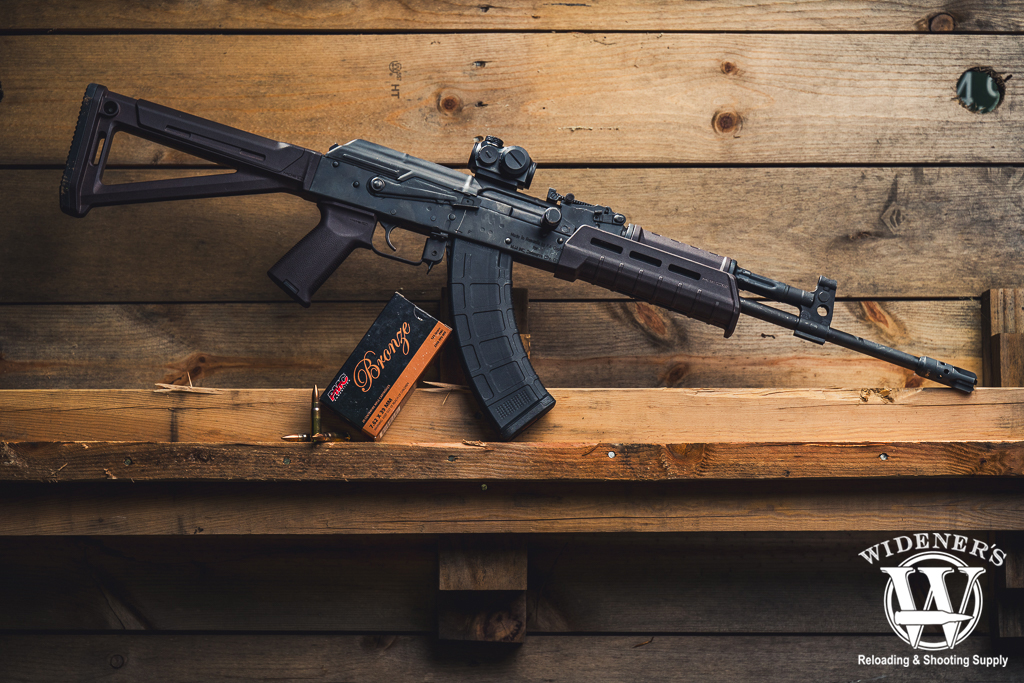
Nyet! Rifle is fine! Over 75 million AK-47 pattern rifles have been produced since their inception in the 1950’s.
Beyond ballistics, the AK-47 and AR-15 have very different operating systems and design philosophies. These affect their reliability, maintenance needs, and performance in adverse conditions.
Operating System
The AK-47 uses a long-stroke gas piston system. When a round is fired, some gas from the barrel pushes a piston attached to the bolt carrier, cycling the action. The gas and carbon are mostly vented forward, away from the shooter.
The AR-15, by contrast, uses a direct gas impingement system (in standard form). It taps gas from the barrel and directs it through a tube straight back into the bolt carrier, where it expands to cycle the action. This system is lightweight and simple, but dumps hot, dirty gases into the receiver. As a result, AR-15s tend to accumulate carbon fouling in the chamber and bolt with repeated firing.
The AK’s piston setup keeps most of that fouling away from the action, contributing to its ability to run in dirty conditions. In short, the AK runs cleaner, while the AR needs cleaning and lubrication more frequently to maintain peak reliability.
Reliability
The AK-47 has a well-earned reputation for reliability under virtually any conditions. Its design has generous clearances (looser tolerances) and robust parts that can withstand sand, mud, and neglect. It’s the rifle often cited as “it just works, no matter what.” Torture tests have shown AKs can fire even after being submerged in mud or packed with debris.
The AR-15, especially in its early days (the M16 in Vietnam), was considered more finicky. Early M16A1s had issues like corroded chambers (before adding chrome lining) and jamming due to incorrect powder in ammo and lack of cleaning. These problems caused some well-documented failures in the 1960s. However, they eventually fixed these issues with upgrades in materials and training.
Modern AR-15s, if kept reasonably clean and lubed, are very reliable for civilian use. Millions of AR owners trust them for defense and sport without issue. Still, in extreme environments or long-term maintenance neglect, the AK-47 has the edge. It surpasses the AR platform in ultimate reliability under adverse conditions.
Maintenance
Because of the above, an AR-15 generally requires a bit more regular maintenance. This isn’t to say ARs are maintenance-heavy (they are relatively easy to field strip and clean), but they do like you to keep them free of excessive carbon build-up and well-oiled for best function. The AK-47 can go longer between cleaning intervals without affecting function. Its chrome-lined chamber and piston system shrug off residue and corrosion.
If you’re the type of owner who isn’t diligent about cleaning your guns, the AK will forgive you more than the AR. Conversely, the AR’s design simplifies detailed disassembly (pushing out two pins and separating the upper and lower receivers). There are fewer major moving parts in the AR-15’s bolt group compared to the AK’s bolt, carrier, piston, and spring assembly.
Both rifles are simple to field strip in under a minute once you know how. Parts availability in the U.S. is also a factor–AR-15 spare parts and replacement components are everywhere. In contrast, AK parts (while robust) can be more niche to source depending on the variant.
Strengths & Weaknesses: AK-47 vs AR-15
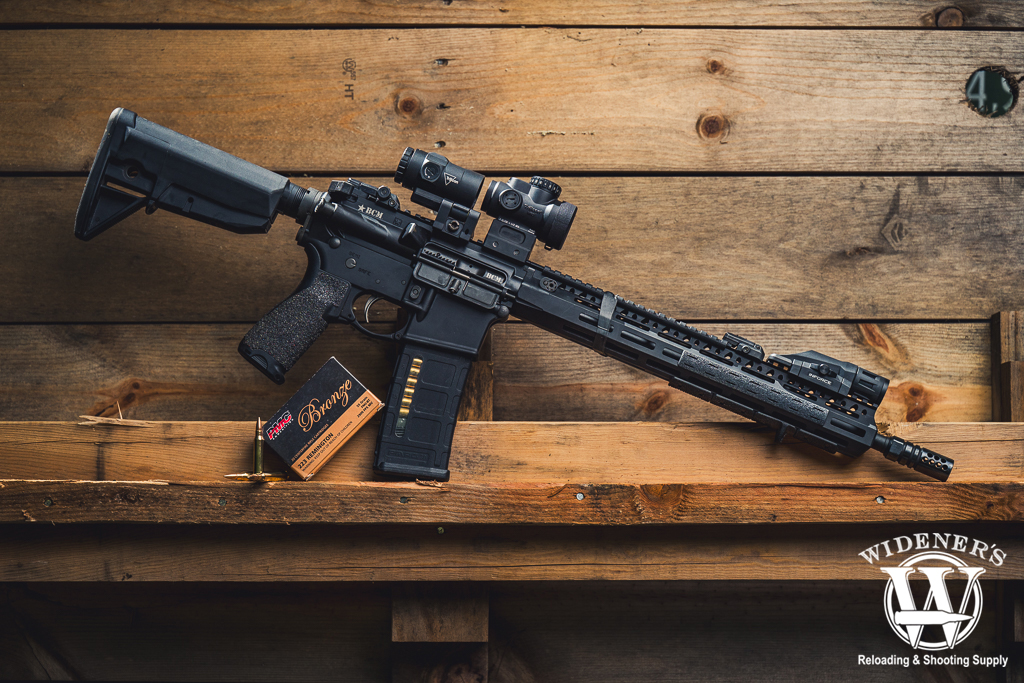
America’s Rifle: Over 20 million AR-15 rifles have been produced since their civilian introduction in the 1960’s.
Having covered the main technical differences, let’s summarize the key pros and cons of each platform in plain terms:
AK-47 Strengths:
- Unmatched Reliability: Functions in extreme conditions (sand, mud, cold) with minimal maintenance. It’s famous for “just working,” no matter what abuse it endures.
- Simplicity & Durability: Fewer small parts, simple to operate, and field strip. It’s tolerant of neglect and rough handling—a true “workhorse” rifle.
- Stopping Power: Fires a larger 7.62mm round that hits hard at close to mid-range. Good penetration against cover; known to deliver strong terminal effects.
- Cost-Effective: Generally, AK rifles (and ammo) are cheaper than ARs. You can find reliable AKs at a lower price point (~$500), and bulk 7.62×39 ammo is often very affordable.
AK-47 Weaknesses:
- Accuracy & Range: Not as precise as AR-15, especially at longer distances. 4+ MOA is common, limiting effective range to ~300 yards for confident hits.
- Ergonomics: Inferior sights and awkward controls (safety and mag release) slow down operation. Harder to use quickly under pressure, and more recoil/muzzle rise in rapid fire.
- Customization Limitations: Far less modular. Adding optics or accessories often requires special mounts or modifications. Fewer aftermarket options; “what you get is what you’ve got” in most cases.
- Maintenance of Accuracy: The loose tolerances and piston movement can degrade accuracy over prolonged fire. The barrel tends to heat up quickly, affecting precision (though the gun will still run).
AR-15 Strengths:
- Accuracy & Range: Excellent accuracy potential (often 2 MOA or better). Flat-shooting 5.56 round and superior sights allow effective hits out to 500+ yards. Great for marksmanship and longer-range shooting.
- Low Recoil & Control: Light recoil impulse and minimal muzzle rise, enabling quick follow-up shots and ease of use for smaller or inexperienced shooters. Stays on target even during rapid fire.
- Ergonomics & Controls: Well-thought-out controls (mag release, safety, trigger, charging handle) make operation fast and intuitive. Easier and faster reloads under stress compared to the AK.
- Modularity: Highly customizable platform with endless accessories. Easy to mount optics, lights, new stocks, change calibers, etc. Users can tailor the AR-15 to many roles and user preferences.
- Weight & Handling: Generally lighter and better balanced. Easier to carry on long treks or maneuvers. Excellent platform for shooting on the move or in competitive timed events.
AR-15 Weaknesses:
- Reliability in Extreme Conditions: While reliable under regular use, the AR-15 is more sensitive to dirt and fouling. It requires regular cleaning/lubrication for utmost reliability, and can malfunction if grossly neglected or submerged in muck. It’s not as forgiving as an AK-47 in harsh environments.
- Maintenance: Related to the above, it needs more frequent maintenance (cleaning the gas system and keeping the bolt lubricated). Not ideal for someone looking for a “zero maintenance” survival gun.
- Over-Customization Temptation: The plethora of accessories can be a double-edged sword – some users sink a lot of money into gadgets. Also, adding many accessories can make an AR cumbersome (though this is optional).
- Cost: Although basic AR-15s are affordable nowadays, top-tier models and customization can drive the price up. High-quality ARs or fancy builds often cost more than a basic AK. Ammo in 5.56 can also be a bit pricier than surplus 7.62×39 (and the AR may not handle super-cheap steel ammo as reliably as an AK.
- Slight Learning Curve: For absolute beginners, the AR’s multi-step takedown (pins, bolt group disassembly) is a bit more complex than the AK’s straightforward design. However, this is a minor point and can be easily learned.
Both rifles are very capable of meeting their intended purpose. Many of the “weaknesses” are relative – for example, a well-maintained AR-15 is highly reliable for civilian use, and a well-trained shooter can run an AK-47 remarkably fast.
Recommended Uses & Applications: AK-47 vs AR-15

Designed by Mikhail Kalashnikov in the late 1940s, the AK-47 is built for simplicity and reliability in harsh conditions.
Now let’s talk about which rifle platform might better suit various use cases that a gun owner might consider:
Home Defense
Both the AR-15 and AK-47 can serve in a home-defense role, but most would give a slight nod to the AR-15. The AR’s lighter recoil and superior ergonomics mean quicker target transitions and easier use in tight quarters. Its standard .223/5.56 ammo, especially in hollow-point or varmint loads, has less risk of over-penetration through walls compared to 7.62×39 (which tends to punch through obstacles with more momentum).
The AR-15 also readily accepts accessories like weapon-mounted lights and red dot sights, which are useful for home defense scenarios. An AK-47 has plenty of close-range stopping power for defense and can be utterly reliable in life-or-death situations.
Just be mindful that 7.62×39 FMJ rounds will penetrate many layers of drywall. If using an AK for home defense, consider specialized defensive ammo (if available) or plan fields of fire accordingly. In short, the AR-15 is generally the better choice for home defense due to controllability and accessory options, but an AK-47 in trained hands can be equally effective at typical indoor ranges.
Recreational & Sport Shooting
For general plinking at the range or sport shooting, the AR-15’s accuracy and low recoil make it a joy to shoot for extended sessions. The AK-47 is great fun for casual plinking—the recoil is still moderate, and there’s visceral enjoyment in the “boom” of the 7.62×39. AK ammo has historically been very cheap (steel-cased imports), so mag-dumping an AK can be easier on the wallet.
If you’re into competitions (such as 3-Gun or action shooting sports), the AR-15 is the predominant rifle used, mainly because of its fast handling and precision. The AR also has an edge in ammo availability for range use; .223 Remington is ubiquitous in the U.S., and you can get a wide variety of ammo, including inexpensive bulk for training. Hunting
Choosing between these rifles for hunting depends on the game and environment. The AK-47’s 7.62×39 ballistics are comparable to a .30-30 Winchester, a proven medium-game (deer) caliber at short to moderate range. With soft-point hunting ammo, an AK can certainly take deer or hogs within ~150 yards effectively. Its limitation is velocity and trajectory – beyond 200 yards, the drop and energy loss make it less ideal.
On the other hand, the AR-15’s standard 5.56 is borderline for deer-sized game (in many jurisdictions it’s legal, but using proper expanding bullets is critical). Due to its flat trajectory, the 5.56 excels for smaller game and varmints (coyotes, groundhogs, etc.). If your focus is varmint or pest control, an AR-15 with an optic is a fantastic choice. For larger game like deer, if limited to these two, the AK-47 has an edge in power, assuming you use appropriate hunting ammo and keep within a reasonable range.
Conclusion: AK-47 vs AR-15 – Which Should You Choose?
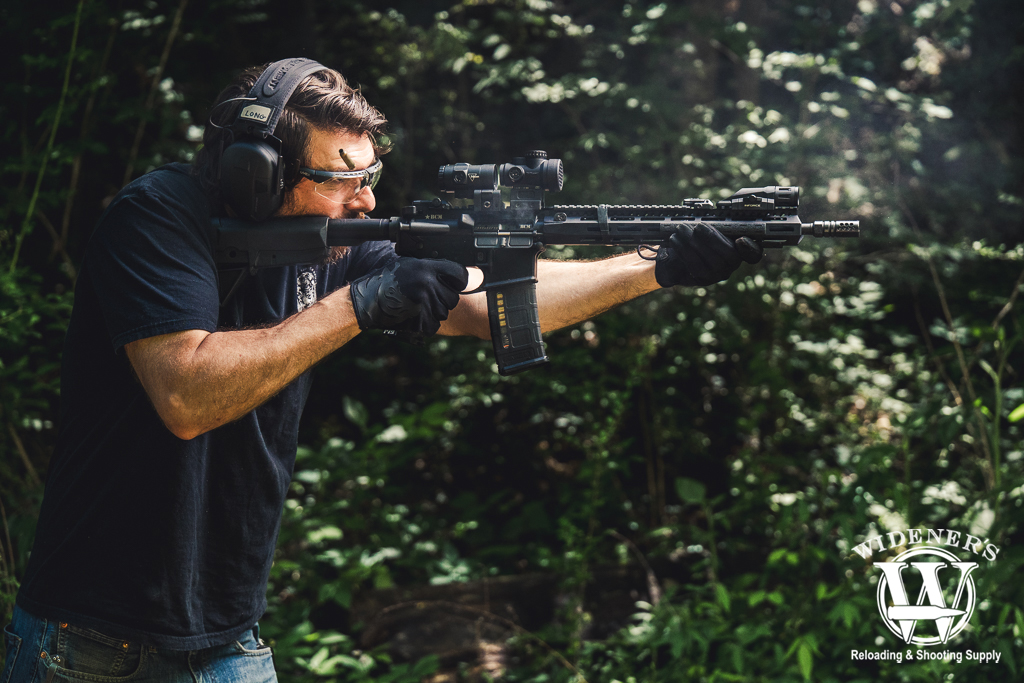
Developed in the U.S. by Eugene Stoner in the 1950s, the AR-15 is designed for accuracy, reduced weight, and modularity.
Choosing between an AK-47 and an AR-15 depends on your priorities and intended use. There is no universal “best” – each rifle excels in different aspects:
If you value rugged reliability, low maintenance, and raw close-range power – for example, you want a rifle that will function in the worst conditions with minimal care – then the AK-47 is very appealing. It’s a rifle you can depend on like an old farm truck; maybe not the fastest or fanciest, but tough and straightforward.
If you value accuracy, range, and customization – say you plan to shoot at varied distances, maybe attach optics or lights, or you want to compete or train with maximum efficiency – the AR-15 is likely the better fit.
Many enthusiasts eventually own both, appreciating the AK for its historic simplicity and the AR for its modern performance. I can relate to the “buy both” approach and am currently looking for an AK to add to my collection.