
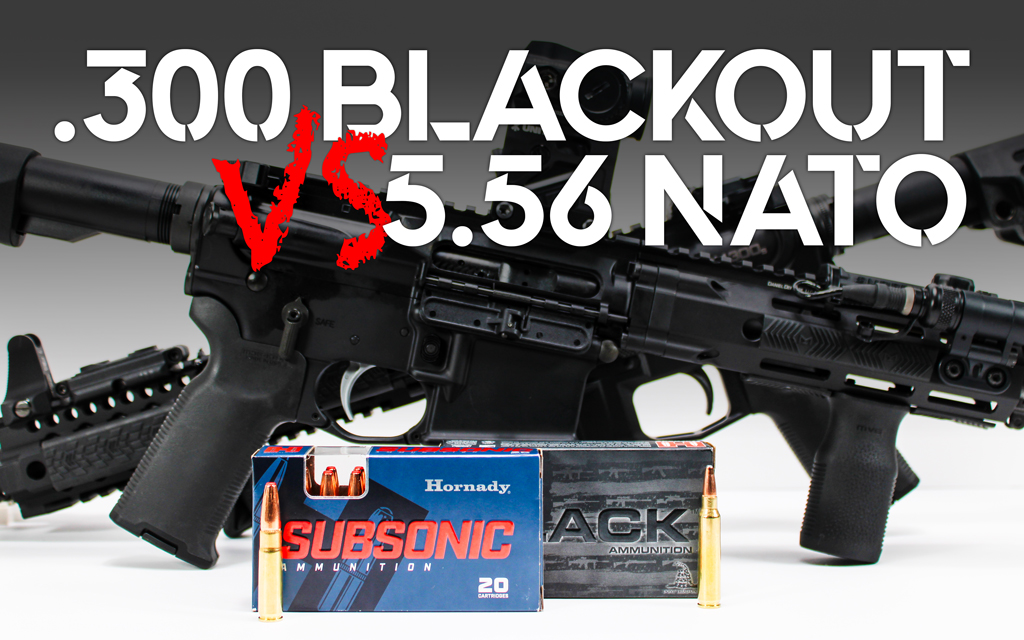
So, what to get? 300 BLK vs. 5.56 NATO is a hot debate. AR-15s rule the roost as America’s rifle. The rifle’s proliferation is due in part to decades of use by our armed forces, which have made generations of young men familiar with the platform. On top of that, the AR’s standardization means parts are largely compatible across the board. A user can start with a serialized lower receiver and configure a rifle to serve whatever purpose they may need.
The recent reduction of the $200 tax stamp fee to $0 makes it more compelling for users to buy or convert their existing ARs into short-barreled rifles (SBRs). That puts users at a crossroads: what caliber to pick? In a short-barreled configuration, the two most likely options are 300 Blackout and 5.56 NATO. I’ve shot thousands of rounds of both out of short-barreled ARs, and both have their place, with positives and negatives across the board. Below, we will pit the two against each other and see how the rounds stack up to your needs.
300 BLK VS 5.56 NATO
The 300 Blackout was standardized by SAAMI in 2011 and is based on the 5.56/223 Remington case necked up to .308″. However, there is some confusion about the cartridge’s origin. J.D. Jones of SSK Industries originally necked the .221 Remington Fireball to .30 caliber. This round, the 300 Whisper, is nearly identical to the 300 Blackout, which was standardized by AAC (Advanced Armament Corp). Why the two? J.D. Jones trademarked the name and required manufacturers to sign a licensing agreement to use 300 Whisper. This led to AAC’s joint effort with Remington to develop a “new” cartridge.
However, it’s safe to shoot 300 Whisper in 300 Blackout-chambered rifles (but not the other way around). Hornady’s eleventh edition reloading manual even recommends using 300 Blackout data for 300 Whisper.
The 300 Blackout was designed to deliver heavy .30-caliber bullets at subsonic speeds to overcome obstacles that stunted the 5.56. Bullet weights range from 110 grains to 225 grains, giving the 300 Blackout great flexibility in both subsonic and supersonic performance.
European Persuasion
5.56 NATO came out in the early 1960s. The 5.56 NATO became the primary rifle cartridge for nearly 60 nations. It was derived from the 223 Remington, which in turn was designed to replace the inadequate 222 Remington. The NATO-spec model differs from the commercial 223 Remington in a few key ways.
Notably, the chamber throat of a 5.56 is longer. Placing a 5.56 NATO round in a 223 Remington will cause chamber pressures to spike about 10,000 PSI above normal operating levels. Eventually, the 223 Wylde chamber was developed as a hybrid between the two. (Note: 223 Wylde is not a cartridge.) You can use 5.56 NATO for varmint control and service rifle matches, but it excels as a defensive cartridge.
| Cartridge Specs | 5.56 NATO | 300 Blackout |
| Parent Casing | 223 Remington | 5.56 NATO |
| Bullet Diameter | .224″ | .308“ |
| Neck Diameter | .253″ | .334″ |
| Base Diameter | .378″ | .378″ |
| Case Length | 1.760″ | 1.368″ |
| Overall Length | 2.250“ | 2.260″ |
| Grain Weight | 55gr.-90gr. | 110gr.-225gr. |
| Max Pressure (SAMMI) | 60,000 PSI | 55,000 PSI |
300 BLK vs. 5.56 NATO: Cartridge Specs & Overview
Ballistically speaking, this is where things get murky when comparing 300 BLK and 5.56 NATO. They are designed for radically different purposes. To keep this consistent, I’ll be comparing each cartridge’s use in an SBR—something under 11.5”.
Dimensions for the 5.56 NATO:

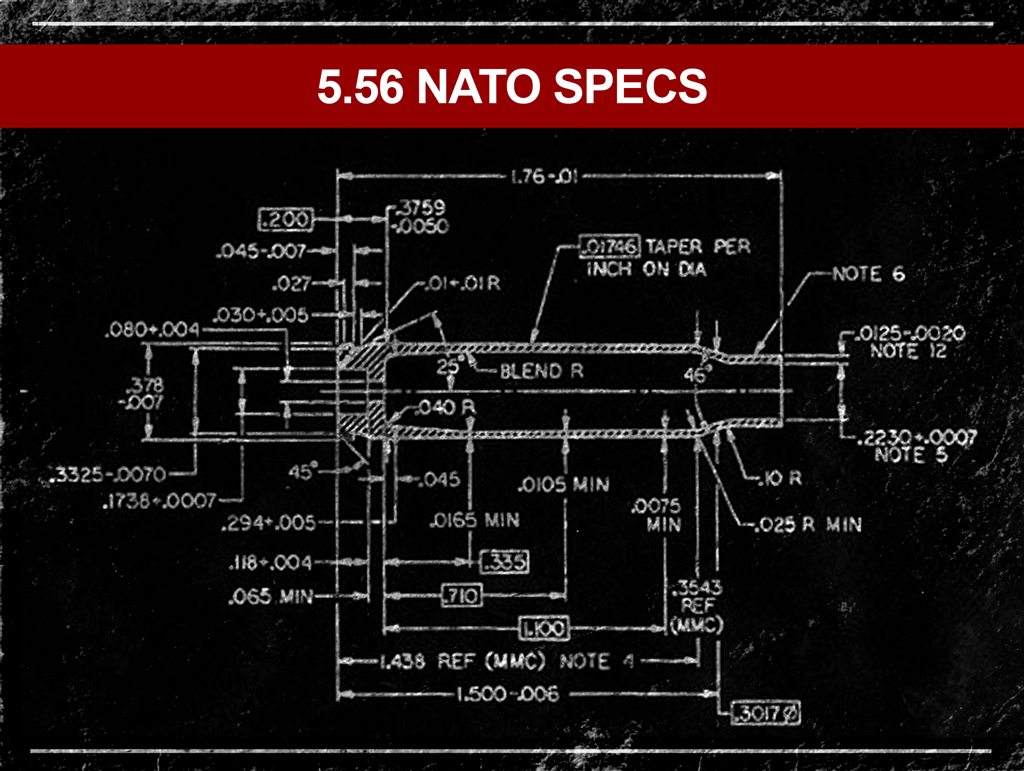
Though they are almost identical, the 5.56×45mm NATO cartridge is derived from the .223 Remington cartridge.
- Designed: Late 1970’s
- Designer: FN Herstal
- Type: Rimless, Bottleneck Centerfire
- Case capacity: 28.5 grH2O
Dimensions for the 300 Blackout:
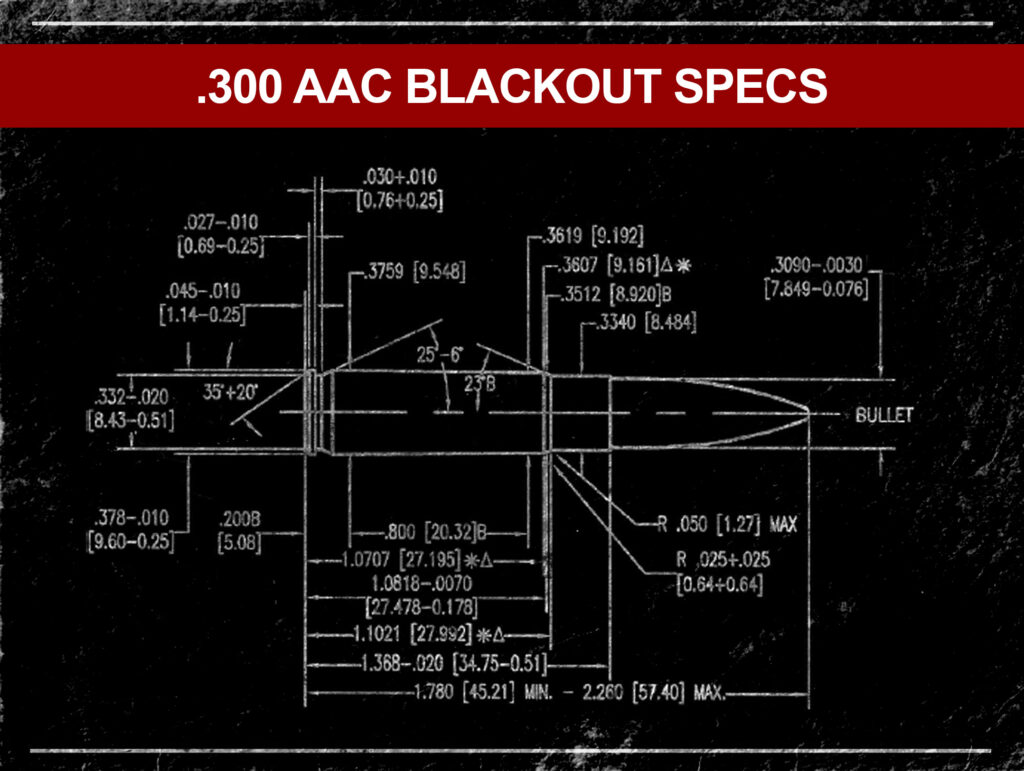
.300 Blackout has the same bullet diameter as the .308 Win; its shorter case makes it roughly the same length as .223 Rem.
- Designed: 2009
- Designer: Advanced Armament Corporation
- Type: Rimless, Bottleneck Centerfire
- Case capacity: 19.2 grH2O
Cartridge Comparison
There is no shortage of centerfire ammo options for both the .300 BLK and the 5.56 NATO. I selected these loads because the same manufacturer produces them and they have similar intended uses. I chose the most purpose driven comparison I could find: the Hornady 5.56 NATO 75gr HD SBR and the Hornady .300 BLK 190gr Sub-X. Take a look at how they match up below:
Hornady 5.56 NATO 75 gr HD SBR
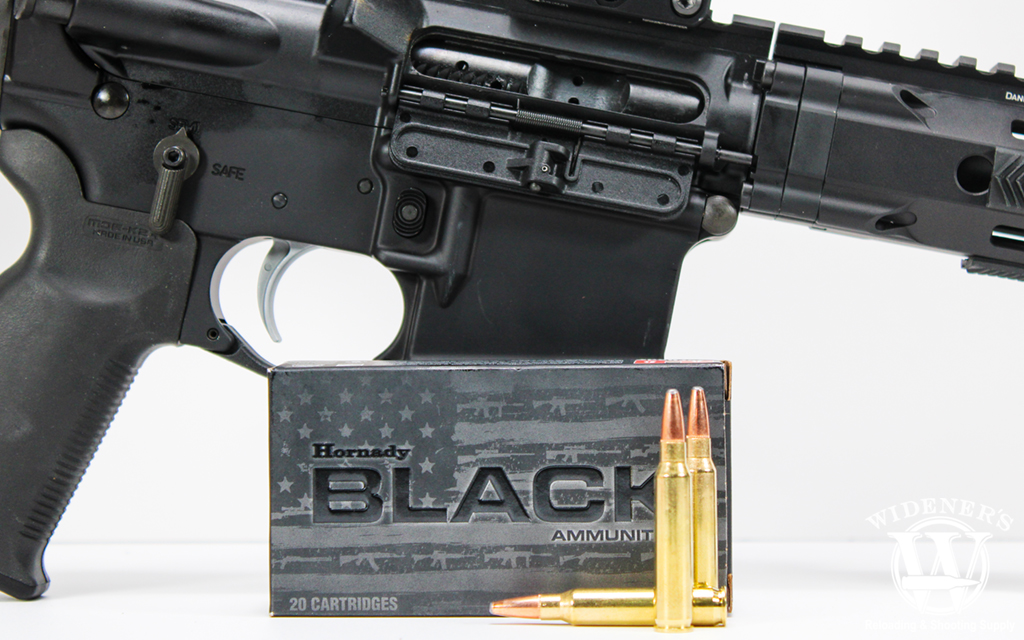
The Black line from Hornady uses proprietary propellant technology and a modern bullet design. (Photo: Cory Ross)
Hornady offers a unique option in its Black line of ammunition for this purpose. It is the 5.56 NATO 75 gr. InterLock HD SBR (#81296). Using proprietary propellant technology and a bullet design derived from Hornady’s Critical Duty FlexLock bullets, this loading delivers exceptional performance in SBRs, whether suppressed or unsuppressed. It produces virtually no flash or residue, dramatically reduces the sound signature, and provides uniform velocity and accuracy. It will not foul or overheat suppressors and is designed to meet the requirements of the FBI protocol.
This round is the optimal choice for 10.5″–11.5″ barreled 5.56 rifles. While 5.56 is not typically considered the ideal choice for an SBR—because unburned powder in a short barrel can cause massive flash—thousands of them exist. While there may be better alternatives, it’s hard to beat the price and availability of 5.56 NATO ammo and rifles.
| Caliber | Bullet Type | Bullet Weight | Velocity (Muzzle) | Energy (Muzzle) | 100 Yards (Velocity/Energy) | 200 Yards (Velocity/Energy) | 300 Yards (Velocity/Energy) |
| 5.56 NATO | HD SBR | 75gr | 2321 FPS | 897 FT LBS | 1974 FPS/649 FT LBS | 1662 FPS/460 FT LBS | 1393 FPS/323 FT LBS |


Hornady 300 BLACKOUT – 190 GR. SUB-X
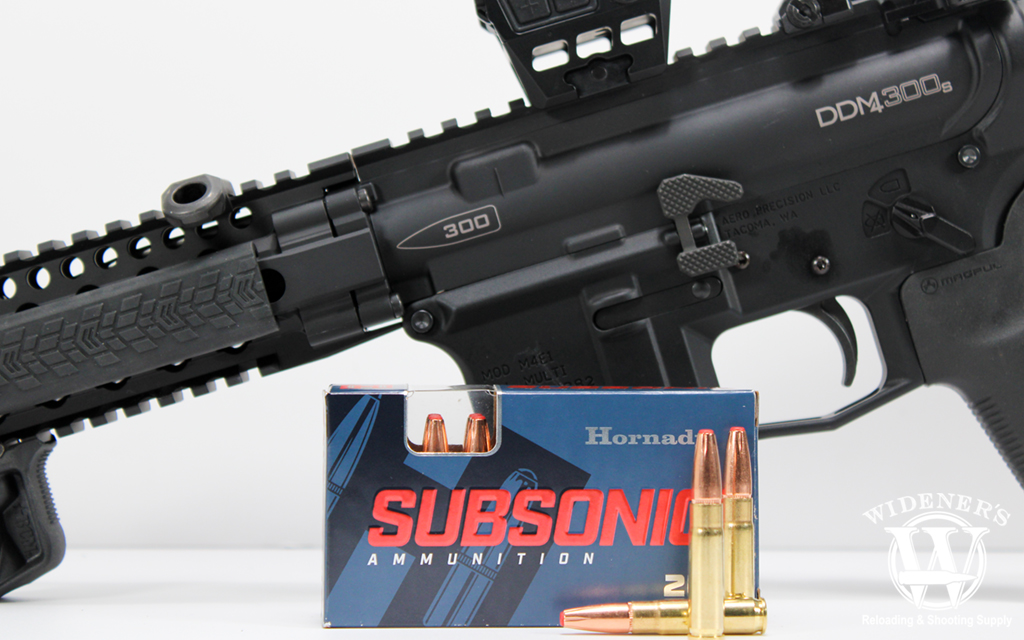
Hornady’s Sub-X bullets are optimized for suppressed rifle platforms. (Photo: Cory Ross)
Hornady developed the Sub-X projectile, optimized for subsonic shooting, in 2017, and it is loaded in its subsonic cartridge line (both rifle and pistol). My go-to has been the Hornady 190 gr Sub-X, loaded in a bedside 300 BLK rifle (I mean, a large-format pistol). The Sub-X bullet used in Hornady’s Subsonic Rifle ammunition features a lead core. Long grooves in its gilding metal jacket, combined with the bullet’s flat profile and the patented Flex Tip insert in its hollowpoint cavity, help it expand reliably at low velocities.
| Caliber | Bullet Type | Bullet Weight | Velocity (Muzzle) | Energy (Muzzle) | 100 Yards (Velocity/Energy) | 200 Yards (Velocity/Energy) | 300 Yards (Velocity/Energy) |
| 300 BLK | Sub-X | 190gr | 1050 FPS | 465 FT LBS | 998 FPS/420 FT LBS | 955 FPS/384 FT LBS | 918 FPS/355 FT LBS |
Pros & Cons of 300 BLK vs. 5.56 NATO
The Pros of 5.56 NATO:
- Commonly available with affordable pricing
- More rifle options than any caliber currently available
- Great ammunition variety
- Excels at medium ranges
- Great for varmint hunters
The Cons of 5.56 NATO:
- Not optimal for short-barreled rifles
- Increased pressure when running suppressed, causing increased wear and tear on small parts
- Less barrier penetration compared to 300 BLK
- Higher flash signature out of short barrels
The Pros of the 300 Blackout:
- Excellent in short barrels
- Subsonic ammo offerings
- Excellent for suppressed use
- Less wear and tear on AR-15 small parts when running suppressed
- Great ballistics for CQB
- Easy conversion for your AR-15. Only need to swap the barrel
- Great for hog hunting and other thick-skinned varmints.
The Cons of the 300 Blackout:
- Ammo is on the expensive side
- Not as widely available as 5.56 NATO
- Might not work in ALL 5.56 magazines
- Not designed for long-range shooting
- Supersonic offerings aren’t as ideal as the subsonic ones
Best Uses for 300 BLK VS. 5.56 NATO
The best uses for 5.56 NATO are as follows:
- High-volume training
- General Purpose rifle
- Varmint hunting
The best uses for 300 BLK are as follows:
- Running suppressed in a short-barreled rifle
- Hog hunting
- Home Defense
300 BLK VS 5.56 NATO: The Main Differences

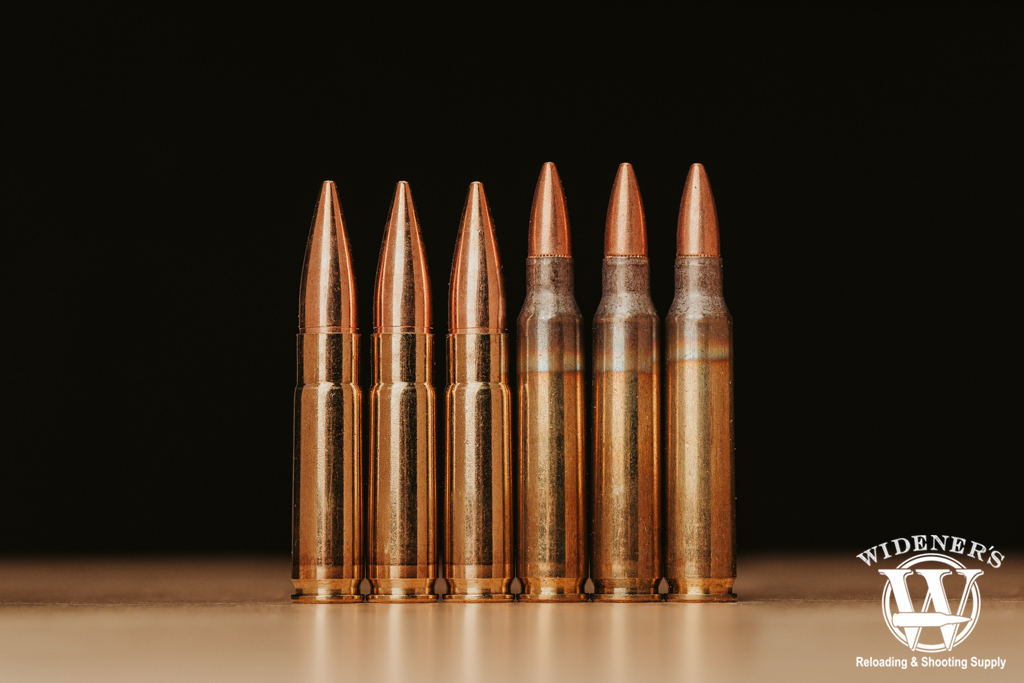
Tête-à-Tête: The .300 Blackout cartridge (Left) VS. the 5.56x45mm NATO cartridge (Right).
To start, both cartridges are excellent options for their intended roles. But it’s up to you to define that role. Purpose drives selection; in this case, it will determine which cartridge you choose.
300 BLK
The 300 Blackout is the optimal cartridge if you plan to run suppressed from a short barrel, mainly for CQB (or anything within 100 yards). However, after that, its performance diminishes. Yes, supersonic ammo exists, but if you’re tailoring an SBR for suppressed use, switching between subs and super may cause issues with proper ejection and cycling. Tuning the gas system is most important, and constantly having to adjust it when switching back and forth can be irritating.
5.56 NATO
Conversely, if you prefer a more general-purpose rifle setup, that’s where 5.56 NATO comes in. I know a lot of people who shoot 5.56 in the 11.5-14.5” range well past 600 yards. This makes it an effective, do-everything rifle. This concept is especially effective when using heavier projectiles, such as the 75 gr. HD SBR.
In my experience, this weight class performs better than the common M193 or M855 usually found in bulk. This really elevates the rifle’s performance at longer ranges. The important thing is to use a faster barrel twist rate, such as 1:8 or 1:7, to better accommodate the heavier bullets.
For sportsmen, the 300 BLK has become a Hog Killer and is used by hunters all over. In states that allow it, the 300 BLK is also an excellent option for deer at reasonable ranges. Its heavy bullets are designed to penetrate the thick skin of game animals.
In my area, I know many people who hunt coyotes with 223/5.56 rifles. There are a ton of ammunition options for the task, specifically in the 223 Remington chambering. Effective range is significantly greater than that of the 300 BLK.
To sum it up, 300 BLK is perfect as a CQB rifle/dedicated suppressor host. It can also moonlight as an excellent hog rifle. 5.56 NATO, on the other hand, is best as a general-purpose rifle that can handle a multitude of scenarios, including varmint control.
A Brief History of 300 BLK
Originally developed by Advanced Armament Corp. in collaboration with Remington Defense, the .300 Blackout was designed to give the AR-15 platform greater versatility without requiring a new bolt or magazine. Introduced in 2011, the cartridge quickly gained a following for its ability to reliably cycle both supersonic and subsonic loads while delivering improved performance from short-barreled rifles.
A Brief History of the 5.56 NATO
Developed in the late 1950s and officially adopted by NATO in 1980, the 5.56 NATO cartridge has become one of the world’s most widely used rifle rounds. Designed for lightweight rifles with controllable recoil, it offers flat trajectories, high velocity, and dependable performance across a wide range of applications. From military service to competitive shooting, hunting, and home defense, the 5.56 NATO remains the benchmark cartridge for the modern sporting rifle.
300 BLK VS 5.56 NATO: Better/Best?
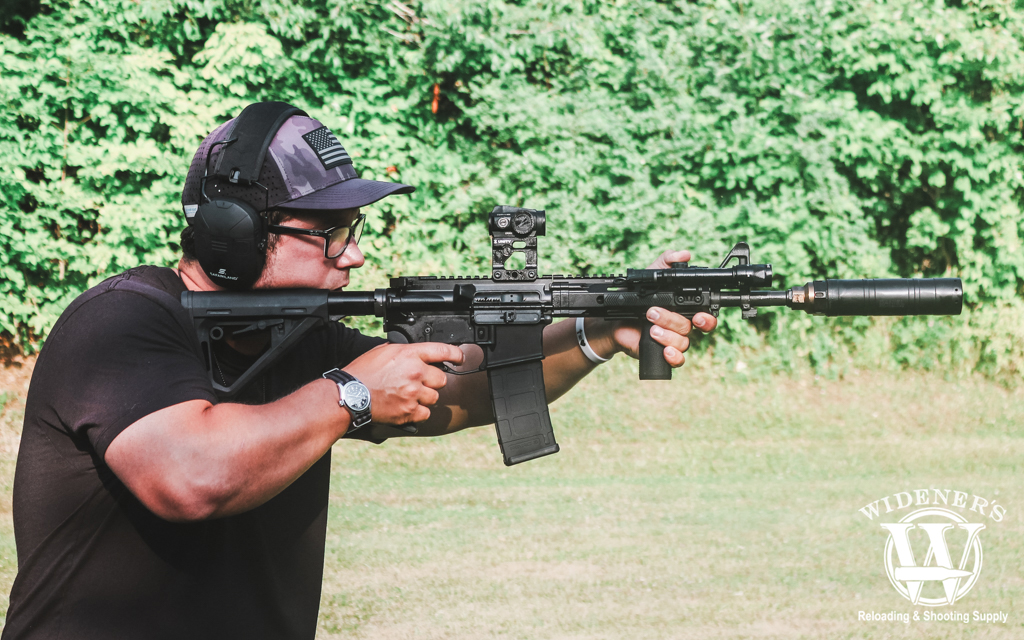
Choosing a caliber for your SBR rifle is a matter of finding the right tool for the right job. (Photo: Cory Ross)
At the end of the day, there isn’t a “wrong choice.” It’s about finding the right tool for the job.
If your goal is a compact, suppressed rifle for home defense, close-range work, or hog hunting, the 300 Blackout is hard to beat. 300 BLK was purpose-built for suppressed shooting in short-barreled rifles and continues to excel in that role.
Looking for a rifle that can handle everything from training and range days to predator hunting and defensive use? 5.56 NATO still reigns supreme for its affordability, availability, and impressive versatility.
The good news is that both cartridges share the same AR-15 platform, making it easier than ever to build or convert a rifle for your intended purpose. Before buying parts or stocking up on ammunition, take an honest look at how you’ll actually use the rifle. Once you answer that question, the choice between 300 Blackout and 5.56 NATO becomes much more straightforward.